Roger Nelson
GCP blog
This page is the repository for the occasional updates I have been sending to the GCP mailing list every two or three months over the past several years. I've decided to make the actual note sent via email very short, just an announcement and a link to the current update. This puts a smaller load on the web, and on everybody's mail queue. As time becomes available, I will add archived issues.
GCP/EGG Update September 7 2014
I have to admit some considerable distraction lately, with the result it has been a long time since I added a "blog" entry. But here we are. One of the things that has occupied me personally is building a house in an ecovillage near Ithaca NY, where our son and several other families have created the beginnings of a community with values we share. It is called White Hawk Ecovillage, and if you go there, be sure to look at the short video called "White Hawk YouTube Video". That presents some of the attractions in a delightful way.
I am also occupied, but so far not as productively as I would like, by the idea that we need a well designed and organized collaboration between and among the many separate groups with a similar intent to do something to help make a brighter future. Many focus on meditation and seek to create the biggest global meditation yet. Others believe music and concerts can bring us all together and gather people from all walks of life to work for peace in the world. Many meetings and gatherings and festivals are designed to honor life and love and compassion. If you have not had invitations to join from one or another of these efforts, it would be very surprising. What I would like to see is a kind of clearing house, or rather, a facilitation process introducing all the separate centers of energy to each other. The idea of bringing synergy and joined campaigns seems not only ripe for implementation, but a kind of manifestation on a practical level of the global consciousness we believe is forming. It seems natural to join together since the goals are shared, and I think the only barriers are "investment/ego" issues -- which must be minor -- and the missing central organizing function. I've been thinking about this long enough to realize I am not personally the one we need to do the organizing, but I will help anyone who chooses to step up. Just needs a kind of easy access web presence, a forum, bulletins, and some functions we can imagine but haven't seen to create integration and the power of "two heads" and more working together.
One of the ways this can be extremely important is by attracting, slowly but necessarily, attention and contribution from people on the other side of the fence, especially people in positions of power and influence. One of the facts we must recognize is that there are many individuals and groups (I think of corporations) who presently believe their benefit lies with the status quo, where we have war and violence and careless greed that is eating our world alive. It must be clear that the status quo destroys resources and lives and wastes creative possibilities -- for a return of low value compared to what is possible. Logic says the destruction can't be as profitable as a constructive application of the same resources. So, here is a question that needs very many minds concentrated on achieving an answer: How can we redirect the aims of the people in power politically and economically so they strive for constructive ends, and seek an end to destruction?
Compassion works. It is probably the single most powerful antidote to the ills that we need to overcome. It should be possible to re-train ourselves and our leaders to choose compassion. (This makes me think of the GWBush claim to be a compassionate conservative. But that is practically an oxymoron -- compassion doesn't come in colors.)
Now to a bit of comment on the Project's work. The past few months have seen so much turmoil in the world. Many of us think there must be a way for the Global Consciousness Project to observe it, but much of the time, the disturbances are long-term roiling of the waters rather than events. Our "instrument" works most effectively for short, sharply focused events because when we look at only a few hours, the chances for other, competing events is limited. On the other hand, when we wish to consider something like the ongoing tragedy of the Israeli-Palestine conflict, there will be any number of other things happening in the world -- we can't isolate effects that might be due to the middle east conflict alone. What we can do is identify moments of higher intensity, attracting attention from around the world which is more concentrated. We use "probes" that may give us a momentary sample of the ongoing effects. Though this may need to be informal (not included in the long-running formal replication series, it can provide useful information while also asking the GCP network about events which deeply affect us. An example is the apparent murder and retaliation of innocent young people from Israel and Palestine. Sadly, these tragic and horrifying events are not sufficient to change the course of the conflict. We can hope for a better future. Send a prayer.
GCP/EGG Update January 1 2014
We have a new website design, courtesy of Marjorie Simmons. It uses CSS and HTML5, so the GCP web presence is up to date and representative of the sophisticated research. The new website is being launched today, January 1st 2014, so it is a Happy New Year presentation. Only a few of the most accessed pages have been converted as of Jan 1, so stay tuned, and if you have some useful critiques. please let us know.
GCP/EGG Update December 12 2013
The New Year is practically upon us, and it is high time I wrote an update. It has been an interesting and busy time, and that implies some distractions. For example, I have fairly frequent interviews and meetings with interested people, as well as invitations to contribute articles or book chapters. Some of the latter seem good practice for the book I am writing, much too slowly.
An example, for those of you who read German, is an article (actually a translated interview) by Detlef Scholz to be published in Raum & Zeit (Space & Time). He sent a copy for proofreading, and it is a nice job, with good technical understanding, and as it happens, some free-ranging discussion toward the end about why the GCP research and findings might be of value. I have been shifting more toward such questions in recent years, partly because the project's findings and data are ever more clearly sound in the scientific sense, allowing me to feel more free to interpret what we have found.
Another interview article is in French, by Stephane Allix, published a couple of months ago in Inexplore (Unexplored) which is sold in France, Belgium and Switzerland. Allix also has a TV program called “Enquês extraordinaires” (extraordinary investigation) in France. You can learn more at inrees.com
The Japanese TV company, NHK, has characteristics of CNN and PBS in the US, and has or will soon broadcast a program in Japan with interviews from several consciousness researchers, including me. They hope to sell an English version of the program but I haven't heard about progress.
A short, accessible, article about the GCP is due in the current issue of MindField, the popular magazine published by the Parapsychological Association. You should consider supporting the PA, and also the Society for Scientific Exploration. These are the two professional organizations I turn to for serious interests at the edges of what we know. Both look at important but challenging issues that are too difficult for much of academia.
Coming soon, I will be a guest on a program called “America Meditating” with Sister Jenna Mahraj, who is a teacher with a broad range. Should be interesting. The time is Monday 16 Dec at 08:00 ET.
The most recent volume of Advances, Stanley Krippner's long series of books treating professional research in Parapsychology, was recently published. It includes a chapter on the GCP. The editors for this volume are Krippner, Julie Beischel, and Harris Friedman, and the publisher is McFarland.
Coming soon is a book called The Science of Psi, edited by Damien Broderick and Ben Goertzel, which includes two chapters on the GCP, one by Roger Nelson, and one by Peter Bancel. It's scheduled for publication sometime in 2014, so this note may be a bit early. But you can get a flavor of Peter's chapter from a Webinar he did a few weeks ago. The Global Consciousness Project webinar recording has been posted.
With all that activity writing and talking about the data and results, I'm pushed to think about implications. I am also writing about that in response to a request to think about “Implicit Physical Psi,” which refers to the idea that “psi” happens even when nobody is thinking about it or intending anything. That is, we don't have to have someone wishing or willing to change an RNG's behavior, though that is the usual laboratory model. When we branched out to Field studies, going to concerts, cathedrals, and sacred sites, and finding indications of group consciousness effects on the local RNG, the implicit link was between the RNG and a group deeply engaged in something, but typically unaware of the RNG and the experiment. Of course the GCP is a global scale expansion of this situation. The implicit linkage is common to many kinds of experiment, but the important questions are about what this might mean for us. What can we learn about consciousness and who we are, what potentials we have? This is what seems of increasing importance to me. In the context of a world where there is a tremendous increase of communication but a real concern that we are increasingly isolated (earplugs in, texting screen on, gaming scores up), with most of our attention focused inward, it seems our best energies are often given to challenges that don't matter.
What often is missing are opportunities to be creative. To invent from the ground up, using the mind and heart as both vehicle and driver. Suppose the GCP's finding that something changes in the world when we connect unconsciously (no mobile technology needed) correctly reflects some facts about consciousness that we haven't known. Suppose we come to know about it, and then come to incorporate such knowledge in our self-perceptions and our interactions. We can, in principle, use some of our “best energies” to work on the challenge of connecting deliberately and deeply. What would happen if this came to occupy many of us in a manner similar to the ubiquitous texting one sees all around? I imagine a pretty joyous feeling, much like that we all have experienced as love–for another person, for a family or circle of friends, for one of our four-footed friends. You can't text your dog, but you can connect.
Enough philosophizing. What's been happening lately?
The bottom line composite score across the whole database, which now has more than 450 formal analyses has fairly clearly passed the seven sigma level, with the current Z-score at 7.225. The most recent event contributed a big increment. You will not be surprised that many people identified the death of Nelson Mandela as a major global event. It did indeed bring untold millions together in a shared focus on the man and his character. That shared emotional engagement is the power behind the GCP correlations. It is the condition when we are most connected.
GCP/EGG Update July 30 2013
About to go traveling again, and want to give greetings to people interested in the GCP, and to give an update on what's been happening.
Recent professional travel took us to Germany for a day-long conference organized by Quantica, GMBH. It was a pleasure for me, reconnecting with Rupert Sheldrake, and meeting Pim van Lommel, who knows so much about near death experiences. We spent extra time with Dirk Getrost, Alex Walz, and Marco Bischof, who put the symposium together. This was time very well spent. In June we went to Dearborn, Michigan, for the annual meeting of the Society for Scientific Exploration, one of my favorite gatherings. I presented “The Three Rs of the GCP, Replication, Replication, and Replication.” I will post a video of the talk on the GCP website soon.
In a few days, the Project will be 15 years old. We recorded the first trials on August 5 1998, and never looked back, as they say. There were just 3 eggs for the first few days, including during the first formal event we examined, the terrorist bombings of US Embassies in Africa on August 8. By the 10th there were 4 eggs, 5 by the end of the month, and then growth over the next years to 50 or 60 eggs in the network for most of its history. It is quite a history, in fact, and I have been privileged to see the events of the last 15 years through a special lens. It is hard to imagine paying such close and penetrating attention except through the comparison of our “data history” with the “event history” that records the joys and the trials of humans all around the world. The book I am perennially writing is to be a reflection on that long focus of attention.
The events we've analysed in the past few months have been mostly tragedies, Boston Bombing, Bangledesh Factory, Arizona Firefighters, Spanish Train Crash, but there are, fortunately, some happier moments too. One of these that stands out is the “Royal Birth” of Prince William and Katherine's son. It was a major media event, and no doubt there were hundreds of millions paying attention and looking forward to the announcement. It is just one event, of course, and the accumulated bottom line summarizes results for ∼450 events. The total deviation hovers around 7 sigma, with an odds ratio of hundreds of billions to one against it being a chance fluctuation.
Peter Bancel will be presenting a talk on his analyses of the GCP data in Viterbo, Italy, at the Parapsychological Association Convention. I wish I could be there, and if you are in the general area, you may want to consider attending the meeting. There will be many interesting talks, but I think Peter's will be especially intriguing because he will be describing years of sophisticated analysis. There are always loose ends, or new questions that arise from such work, but for many aspects of his work, Peter is satisfied that the numbers and the implications are clear. There are multiple kinds of structure in the data recorded during our defined global events. The basic effect can be seen as pair-wise correlation–some of the independent eggs produce data that appear to be driven in the same direction. This happens to pairs of eggs that may be thousands of miles apart, but it is stronger when the separation is smaller. This represents a “distance” effect, though it isn't what comes easily to mind–a distance from the event to the eggs. Instead it suggests that a field-like influence from our synchronized reactions to an event may be more effective when the pairs are closer together.
There are other indications of structure in what should be purely random data, and together they become input to modeling or tests of competing models of how the GCP correlations arise. It is a difficult question, and Peter is continuing to chase down the hints and the problems that make any simple answers unlikely. The good news is that the data push us to think about how they can be accommodated. They hold the potential for insights linking consciousness into physical models which otherwise ignore mind, and thereby one of the uniquely defining characterics of living beings.
Those of you who are egg hosts will have the pleasure of “meeting” Paul Bethke, who has begun helping maintain the Egg network in a more public way. Paul created the Windows version of the Egg software at the beginning of the project, and has been helpful solving problems for many egghosts along the way. I asked if he would like to take a broader role and he agreed–for which I am grateful. I hope it might even give me more time to write, or at least less reason to think I don't have time. :-)
GCP/EGG Update March 18 2013
I will be leaving shortly for Modena, Italy, and a conference called “The Circle of Life.” Among others, I will be seeing there Rollin McCraty of Heartmath and the Global Coherence Initiative, and Lynne McTaggart of “What Doctors Don't Tell You.” Looking forward to it, because fundamentally this meeting is about bringing the circle of logic and understanding to enhance and surround deeply important matters of life and emotion. The circle of life is the circle of compassion and love, and that will be what can save us from the spiral of destruction that seeks to draw us all down. Not to be over-dramatic, we do see around us in all directions, from wherever we stand, threats to our very existence. But most of those threats are within our power to defuse by the simplest of expedients. I don't know who first said it, but it surely is true that if we feed our enemy, he will be disarmed.
Perhaps that will be the message of the new Pope, Francis. His first steps are taken with humility and a quite charming smile. We looked at the GCP data just at the time of his election, and for the next couple of hours the data showed a similarly charming slope. It devolved into a more random looking trace, but it is a positive start.
The recent months have been busy ones for the Project, with quite a number of events. As always, the hypotheses we set turn out to be both hits and misses, but as has been the tendency in the past, more of them are hits, actually close to 70%, and they add up gradually but persistently to a highly significant departure from expectation. The accumulation as represented by the composite Z-score now exceeds 7 sigma, and the corresponding probability is on the order of 1 in a trillion: 9x10^–13. What is more compelling is that beyond the high significance of our major statistic, we have half a dozen other indicators of structure in the data.
We watched the End of the Mayan Calendar pass, fortunately without much in the way of apocalypse, but with lots of people attempting to be more conscious and more connected. We saw in a New Year, and tuned into the pomp of a second inauguration for US President Obama. The Kumbh Mela of 2013 was the second Maha Kumbh we have watched, and it gave again evidence of the power of millions seeking in concert a spiritual goal to affect the GCP network.
I've been writing, and have made great progress on a book that documents the EGG Project. It is at last looking like I'll finish it in this lifetime :-) although there is lots to do still. We all know that the last 20% takes 80% of one's effort, and I expect that to be so here too. But I am optimistic. I've also written chapters for three different books, and two of those are likely to be published soon. More information as it becomes available.
In April, we will have another trip to Europe, this time to Germany. On April 13, I will join Rupert Sheldrake, Pim van Lommel, and Marcus Schmieke in a Quantica Symposium on the Mystery of Consciousness. It will be in Frankfurt Germany and should be a memorable day. Then in June we have the 32nd annual meeting of the Society for Scientific Exploration. This will be in Dearborn, Michigan. My talk there will be entititled The Three R's of the GCP, Replication, Replication, and Replication.
That's what makes the project work, ultimately. We are, as George deBeaumont, one of our earliest collaborators once said, “chasing a subtle beast.” The only hope we have of catching it is by patiently trying again and again, learning from each instance how to refine the “trap” we are setting. It is an interesting thing to look back on repetitions of similar questions. More than just interesting, actually. It bears the potential of intelligent fruit. As a splendid example, take a look at the work of a more recent collaborator, Bryan Williams, whose survey of effects of meditation, prayer, and intention on global harmony shows how much can be learned–and how many new questions may be raised by the patient replication of efforts to learn about special flavors or subspecies of the subtle beast.
GCP/EGG Update December 19 2012
The Global Consciousness Project is in its 15th year. We started designing and building in late 1997, gathered resources and invited the help of friends over the next several months, and collected the first network data in August 1998. We will soon see the 15th New Year celebration, and as always, predict a modest change in both the network variance and the device variance. I especially like the latter measure because, graphically, it looks like what I think so many of us feel–a light-hearted focus on a moment in time. Abstract, but meaningful. As midnight approaches, we look for our partner to give a hug, or we get ready to lift a glass in a toast to the beginning of a new long moment in time. We relax toward this utterly non-material event. And the device variance does the same–its fluctuations decrease as midnight approaches, and then afterward recover to a normal level.
On a different scale, this is what I see happening on the 21st of December, which so many around the world have been anticipating for months or even years. This too is an abstract moment to which we humans have attached importance. And this makes it meaningful. Thankfully, the voices of those who imagine apocalypse have become somewhat muted, and most of what I hear these days, as the 21st comes near, are invitations; opportunities to connect; information about meditations to join; and synchronous singing to celebrate possibility. Above all, what many of those voices are saying is that love is alive and well. I am looking forward to it. Whether or not there are any “big changes” as many predict, we will have come to attention more than is usual, and that can't be bad.
We will have a formal hypothesis test. It is complicated in one sense because there are so many events that might be the sort we look for. On the other hand, there are so many that we can make the event definition rather simple. We will just include them all by setting the formal specification to span the times we know people will be engaged. Then, as time allows, we can also do some more pointed analyses in the exploratory mode, just to see how they look. So, the formal GCP event will be more than 24 hours, beginning, say, two hours before noon UTC on the 21st, and continuing to take in a dozen or more of the larger events I've seen promoted, ending at 20:00 UTC on the 22nd. A few selected search terms on Google will bring you to many events, and even more efforts to sell either the fearsome “end of the world” scenarios, or the “dawn of a new age” propositions. One good collection is given by the Shift Network, which lists something happening in most time zones. Many of these events are listed below. I'm sure there will be other things earlier on the 21st and later on the 22nd, but this will do for our study.
    02:00 am PST (10:00 UTC 21 Dec) to include 11:11, a mystical moment
    10:00 am PST (18:00 UTC) for 30 mins 8000 Yogic Flyers South America
    12:00 pm PST (20:00 UTC) for 3 mins First wave of Global Unification
    14:00 pm PST (22:00 UTC) for 15 mins Ise Oluwa synchronized song
    16:00 (00:00 UTC 22 Dec) Teotihuacan drumming, 700 drums
    18:00 (02:00 UTC) Qigong broadcast
    20:00 (04:00 UTC) World Peace Prayer, Mt Fuji Japan
    22:30 (06:30 UTC) One Billion Oms, India
    12:00 (08:00 UTC) Midnight Breathe As One, LA
    02:00 (10:00 UTC) Muslim prayers to Mecca
    04:00 (12:00 UTC) Findhorn in Scotland
    06:00 (14:00 UTC) Various events South America
    08:00 (16:00 UTC) Hebrew prayers, Jerusalem
    10:00 (18:00 UTC) Unity Village Chapel prayers, Missouri
    12:00 noon (20:00 UTC) Final Wave, Global Birth Moment Agape Center LA
Meanwhile, we have seen a small burst of events recently, ranging from celebration for some (the US elections), to terrible tragedy. The unspeakable horror visited on Sandy Hook Elementary School in Newtown CT is something I would rather not have to put on the GCP list of events. But it must be there, as an example of the worst kind of shock to most of us. Of course it is in some ways very much the kind of tragedy visited on families and communities all around the world where there is armed conflict, terrorism, and war. This is just a sharply focused version of what we (in the US and other Western countries) otherwise do not really see. 20 children 6 or 7 years old murdered, executed in the most brutal way.
The US Presidential election is given attention all around the world, as I know from my international friends. Many of them would vote if they could, since our President wields so much influence and affects what happens in almost every country. This election was also more bitter than most, and seemed to provide a clearer choice than often is the case. So we took a look of course.
These and other recent event analyses can be accessed from the “What's New” box on the GCP home page, or by going to the huge table (more than 420 events by now) of results, also linked from menu on the homepage. The bottom line statistic, compounded over all formal events, now stands at more than 6 sigma (standard deviations). This corresponds to odds against chance on the order of 100 billion.
There are some new papers coming soon, including short descriptions and chapter length, inclusive reports. Stay tuned.
We are entering or already in the midst of Holiday Celebrations, and I hope you will be gathering with friends and family. May the end of the Mayan calendar correspond with the beginning of many good years ahead.
GCP/EGG Update October 29 2012
It seems we are seeing more often the extreme weather events that experts say are one of the obvious results of climate change. The coastal waters off the Eastern shores of the US are several degrees warmer than usual, and this is a source of the huge energies we are witnessing in Hurricane Sandy. Those energies are beginning to impact Princeton, NJ, where I live, even though the storm center is still 200 miles away and won't make “land fall” for 8 or 10 hours. It is likely that we'll lose electrical power for a few days, and since I've been planning to send an update note, now is a good time for it.
Later today I'll set up some exploratory analyses to look at the GCP data during the major part of the storm–even though our technology is better applied to relatively brief events of a few hours. How to assess the impact on GCP data from events that unfold over several days or even longer periods is an interesting problem to consider, and we don't have a good formal approach. Most of the events we examine are of a few hours duration, comprising the spreading response or developing world-wide consciousness of some brief moment with great impact. An explosion, or a crash, and also many natural disasters are just momentary flashes on the screen of consciousness, though with a lingering impact over a few hours in most cases. Sometimes, as in the case of the great earthquake in Haiti, or the tsunami in Japan, it takes days or even weeks for the magnitude of the disaster to sink in. But GCP's basic analysis depends on precise timing to work–because the world is complex and noisy with possible events, we depend on sharp focus to exclude potentially confounding events that are temporally near to the one of interest. If we analyse data from the days-long battering of a hurricane, we will be certain to include time during which any number of other events might engage the global mind. We aren't clever enough yet to be able to sort the disparate potential sources of effects in the GCP data.
We learn from efforts to learn, however, so it pays to go ahead with explorations. What I will do is look for an increase in the number and magnitude of “spikes” of deviation over the several days when the hurricane is a major focus of attention, compared with less “exciting” periods of time. This might lead to a more formal kind of analysis, in which we are able to make specific predictions about changes in statistical characteristics.
My wife and I going to Durham, NC, in a few days (if the storm doesn't intervene). I'm scheduled to give an evening presentation on November 2 for the Rhine Research Center. If you are in the neighborhood, please come by. You can find more information at rhine.org
I have been quiet for a while, mostly focused on the regular maintenance of the EGG network, and on several papers and a chapter for a book in Stanley Krippner's series on parapsychology. Work like this makes me think more deeply than I'm otherwise inclined to do, and that brings up interesting conundrums. One that is always near the surface is the question, “how does it work physically?” A full answer to that kind of question is really difficult, I think, because it requires attention not just to the physics, but to psychological factors for sure, and something that might as well be called the spiritual context. Without going into great detail, what that implies is that it will not be sufficient to measure distances and count bits, even when that is supplemented by the inclusion of emotions and attitudes in our equations. It means that there is a greater depth and a wider scope that we must recognize as part of the picture. In a metaphor, it is like fruit which will not ripen until it is time. That time is tantalizingly near, but it remains unpredictable because there are so few good minds paying attention to real and serious questions about the mind–where is it, what is it made of, what limits does it have and which limitations does it breach?
People ask me, for example, what I think will happen on December 21 2012. They are motivated, probably, by the entertainment industry's perpetual effort to capture our attention, and productions based on their belief that disaster and danger will do that. Thus, we hear fanciful documentary reports, and are encouraged to see horror movies about “the end of the world” as foretold in the Mayan calendar. That, of course, is not a sensible interpretation, as the Mayans will tell you if you ask. But on the other hand, probably by remarkable coincidence, the timing of the end of the Mayan calendar (actually, the end of an age in the calendar) happens to come about the time when we humans really must get serious about the world we affect so powerfully, and until now, so destructively.
I don't know if there will be a change in perception and attitude in December, but it is possible the very wide publication of stories and expectations about this allegedly singular time will make it so. We do know that huge numbers of people will be paying attention, and there are a great many organized efforts to mark this time. So of course, the GCP will set a formal event for the 21st of December, predicting that the attention and focus of millions will in fact create a moment of global consciousness capable of changing the behavior of our instruments. Let's pray that it will also change the way we live on this beautiful blue jewel of a planet.
Now to set up that analysis ... Be well.
GCP/EGG Update June 29 2012
It's time, and it's hot outside so I am taking advantage of my basement office which pretty much always remains cool. Like a cave (indeed many people would see it as a “mancave” of the classic sort.) In any case, I want to do a bit of an update. So much is going on that this may be short, even though the list is long.
I just came back from the SSE meeting in Boulder and as usual I was charmed and informed and sometimes nonplussed, in a good way. My wife says, “This is not just a meeting, it's a family reunion.” That's true, but the family grows and changes. I think a third of the people there were new this year, and that's good. As an example, I got to meet two young physicists from New Orleans who came at my recommendation because it is a place to meet people working at the edges–as Duhe and Thomas plan to do. In August I will be going to my other “family” meeting, the annual gathering of the professional researchers in the Parapsychology Association. That will be in Durham, NC, and if you are interested, go to the PA website for more information. This meeting is more tightly focused on anomalies relating to consciousness, but is always rich with surprises at the edge of what we know–or hope to know.
Just this morning I added another event to the growing list I call the “Obama effect” series. Yesterday, the US Supreme Court issued its ruling on a suit that might have crippled or destroyed the health care law pushed through by Obama and the Democrats in an effort to bring the US within striking distance of a modern, reasonable healthcare system. The court largely validated the Affordable Care Act, in a ruling that surprised most people, not least because conservative Chief Justice John Roberts was the deciding vote in a 5/4 majority. While this is mostly of concern in the US, there is attention around the world because it has been such a major issue in our noisy political culture. The result is positive and substantial though not significant. I have added it to the lengthing series of what I call “Obama effect” events, which now total 11 and have a combined odds of about 1 in 2000 of being chance fluctuation.
We are making progress on setting the GCP DOT running again. It's been slow, but I think we're getting close. It actually works, but puts too big a load on the external server where it is running–so it crashes. That is indeed close. Probably can be fixed by an infusion of money for larger server capacities, but we are looking at a couple of alternatives, including offers to host it. The “we” in this case is really two volunteer programmers, Kevin in England, and Oliver in South Africa, with me as admiring audience. Wish them success–and think positively about manifesting the necessary resources.
There are an increasing number of radio, tv, and movie presentations of the GCP, and I recently put together a list of YouTube versions or excerpts of these, using the search terms “global consciousness” and “roger nelson.” The latter produces quite a few hits, split between Prince Rogers Nelson, the singer, and me/GCP, with a few others. The former produces mostly GCP hits in the first page or two, and includes several I had never seen that use the data and concepts in art pieces. I have posted a list of Links to YouTube videos in roughly appropriate categories, including Scientific, Radio and TV Programs, Non English Language, Art and Music, and Miscellaneous. If you know of others that should be on the list, please send me a link. And if you have a yen for an artful look, check out this link and the others under Art and Music. Oh, also, if you see errors or totally inappropriate items, feedback is welcome.
There seem always to be things brewing. I've had really interesting meetings with some entrepreneurial folks recently, and may get involved in major new aspects of the Project, possibly including expansions. There are a couple of directions those might take, one being a greatly increased data rate for the existing system, and another being a great expansion of the system taking advantage of new technology. Tantalizing possibilities in both directions, and one or the other or both will happen when the logistics fall into place. I'm thinking a bit about “crowdfunding” as a way the money aspect of the logistics might work. If you have experience with that, and an interest (and time) to work on it, send me a note.
Things that are brewing also include what seems to be an increasing growth rate in the number of people and organizations with aligned purposes. That is, I have incoming from ever more people with the desire and often a very active program aimed at helping to create a bright future. We all know how much the road is uphill, but when people are undaunted, purposeful, and persistent, the climb is possible. And when they/we are joined together, it becomes a pleasure. Check out, for example, 1 Giant Mind, a group that has a long view, and an integrative approach. Hmmm, just what we had in global mind.
GCP/EGG Update April 6 2012
Spring is in the air in Princeton. Beautiful weather, just right for working in the garden. But for the moment, I am taking some time at the keyboard for it has been some time since I provided an update on the GCP. There tends to be a lot going on in the background, and without a map much of what happens in the Project remains almost invisible.
The homepage does have a “What's New” box, which always lists the most recent events, and occasionally notes something else that may be of interest. For example, I have just added the analysis of a terrorist attack in Mogadishu, a poignant tragedy because the attack came as the Somalians were beginning to feel the years of chaos might be ending. We can hope that hope will return. “Only” 10 people were killed, but the effect is out of proportion to their number because of the symbolic interference and interruption of progress. The theater that was bombed was only now opened after 20 years of social unrest preventing anything culturally enriching.
Just two days earlier came yet another in what has become a series of horrifying, and for most of us, senseless shootings in schools. This time in a Christian nursing college in Oakland. In this case as in the Mogadishu bombing, a relatively small number of people died, but the shock to our interpersonal humanity is a grave indicator of somthing seriously amiss in our culture. We wonder each time, briefly it seems, how anyone could do this, what happened to so twist a person to such cold, inhmane acts. But we don't give these moments the serious examination required to understand, and thus we are doomed to see it again and again.
I think these are acts of desperation by people who do not belong, who are completely disconnected from the rest of us. The lone killer of innocent students is simply alone, and probably unconscious of the source of his pain and anger. He is not quite human because we are social beings and he has failed to connect. But there is a conscious separation and powerful intention on the part of the terrorists in Somalia. They have coached themselves to be outside the society, actually to regard the center of the society as enemies. Their motivation is to destroy the order and establish a new form they have convinced themselves is correct. There is no understanding of a long and painful history which teaches that human society requires interaction and trust, not force and disdain. Both cases are tragic failures of the normal human condition, and both surely arouse in the global consciousness deep concern and compassion. At the global level these are signs of malfunction, of something like a wound or illness. They seem to create widespread effects–even in nominally separate physical systems like the network of Eggs that is the GCP instrument.
Although I have not yet consolidated them, we have a growing collection of berserker events like the Oakland school shooting. It is possible to put make a series of similar events and test the results for the consistency that should be expected based on their commonality. We have done that for a dozen events in which Barack Obama was central, and found a significant composite outcome, with most of the individual events showing deviations in the same direction. A similar assessment of large-scale meditations shows strong deviations in many cases, but they are as often positive as negative. The overall result is thus essentially null by our standard measure, but there is a suggestion of excess variance across the subset results: p = 0.067. The question whether differences in the type or style of organized meditation matters to the effect on the GCP data is worth pursuing.
On a very positive note, we have an Egghosts map and table again! It turns out one of the newest Egg hosts, in Capetown, South Africa, is also a Java wizard (and more). He's Oliver McDermott, and in the course of just a couple of days, he revamped the Egghosts page, which had been out of commission for a long time due to changes in the workings of Google maps. Oliver also brought the structure up to date and into compliance with current web programming standards. I'm very grateful. We are still missing the GCP Dot, but I think that is coming close to a rebirth thanks to Kevin in London.
Occasionally I do “Explorations” of events I don't think qualify as global. In mid-March, I lost my oldest brother. He was 78 years old, and had gotten more fragile over the last year, so we knew he was on the way. He was a remarkable man, physically handicapped from birth, but very bright and blessed with a rich and charming personalty. He was much loved, and became an important part of the “family” in his nursing home. As I had done when my mother died, I decided to take a look at the GCP data. Although single events can't be reliably interpreted, nevertheless we might learn something. The graph of data on the day of Louis's passing is pretty interesting, and those who are inclined to think the experimenter (that's me in this case) drives the GCP effect may find apparent support for their view.
I will add some more to this update later. This is now done.
conferences and talks
movies and interviews
Website
GCP/EGG Update December 23 2011
In the West, we're well into the Hannukah and Christmas season, and the beginning of a New Year — the much-attended 2012 — is a little more than a week away. I hold in mind good wishes for everyone in the world, all cultures, religions, nations. All of us hope for the next year to be a good one, with progress toward peaceful sharing of the space and opportunities present on our beautiful earth. As always, it seems within reach, and the more we understand the possibilities that our unconcious and increasingly conscious interconnections give to us, the sooner we will mature in responsible caring for our only home. Of course that means caring for each other, and not only those nearest to us, friends and family, but people just like us everywhere. I see suggestions of this interconnection in the GCP data. Events that represent sharing and positive intent seem to produce the correlations that are evidence of the interconnection we predict.
The transfer from the old to the new server is almost complete. We have apparently lost a few eggs, but still have more than 60 regularly reporting. I'll keep working to reconnect with those that haven't made the transition. Maybe someone reading this knows Graham Andrew of Adelaide, AU. I have been unable to reach him because the email addresses I have do not work. If you know him, please help us reconnect. His is one of the longest-running eggs, and it would be good to have it back in the basket.
In the last update note I wrote that we were still negotiating about connecting the old website and domain name, noosphere.princeton.edu, to the new IP address. I'm happy to report that has been accomplished, with the result that (as far as I know) all the external links to the GCP site will now continue to work. I've not actually tested that thoroughly, but haven't heard many concerns.
We have a design for the Multi-Egg project I mentioned in the last update, and it awaits a suitable block of time for the programming. There will be a pilot phase, which I expect might begin in January, then most likely some minor modifications before formal implementation as part of the network. I am grateful to René & Justine Post for their generous support of this project. And I'm excited about the prospect of “learning something.” Which reminds me of the delightful Sufi saying I kept above my desk in the PEAR lab: “Enjoy yourself, or try to learn. If you do you will annoy someone, and if you don't you will annoy someone.” Of course I'm not much motivated by the intention to annoy, but I must say the part about enjoyment and learning seems exactly on point.
Recent events that surprised us include another bombing in a European city, this time Liege, Belgium, by a loner with what seems best characterized as psychopathic perceptions of the world around him. There was also the unexpected death of Korea's “dear leader” Kim Jong-Il, and then the passing a day later of Vàclav Havel, the last president of Czechoslovakia (1989–1992) and the first President of the Czech Republic (1993–2003). If you look at the results from recent events you may be surprised that few seem to produce the clear departures we predict. This may be meaningful, but it is more certainly justifies that the caveat added to each detailed report on the formal events: we are looking for subtle signals in a sea of statistical noise. A short article in a the ‘Backcatter’ section of EdgeScience, #8, pg. 20, presents a detailed discussion of this fact of life for the GCP as scientific research. Edgescience is one of the benefits of membership in the Society for Scientific Exploration (SSE). Another benefit is the Journal of Scientific Exploration where the article on a DAT explanation of GCP effects mentioned in a recent update note has been published, along with responses by Roger Nelson and Peter Bancel, and a “last word” by May and Spottiswoode. JSE is a rare beast in the journal publishing world because it provides a forum for this kind of discussion.
I thought I might write about Karma for a bit, but will save that for a different place. Suffice it to say that I often feel blessed, sometimes beyond ordinary explanation. What is more interesting than personal karma may be cultural karma. It seems certain that good behavior in cultures, based on honesty, compassion and love, will be rewarded. Agression and self-serving are signs of wilful and arrogant ignorance, and it is my guess they will serve ill in the long run. Looking around the world, and looking especially at the growing power of social media interconnections, it is I think becoming more certain that our most influential cultural powers will shift toward an accumulation of positive karmic stores. How's that for optimism?!
GCP/EGG Update October 27 2011
This update has one really major element. After a long run within the Princeton University domain, my former department, Mechanical and Aerospace Engineering, decided it would no longer provide a home for the Global Consciousness Project server. The GCP has a new home at http://teilhard.global-mind.org/ and we have been able continue the data collection and archiving without substantial interruption.
That is the compact version. In reality, the past couple of weeks have been intense, and challenging, at a level that is at once both difficult and exhilirating. I had extraordinary help from Greg Nelson, the original architect of the GCP software, my go-to person for programming, and, not incidentally, my son. We were joined in the marathon efforts to make the transition smooth and effective by Paul Bethke, our Windows and networking expert. Rick Berger has helped to shape the website optimization, and has begun working with David Medina in a full upgrade of the site to incorporate the new design David created.
We are still in the process of tying loose ends together. There are some automatic functions (for example the realtime display and the eggsummary tables) to repair, and there are a number of Egg hosts who still need to change their Egg configuration. (Please look into this if you are an Egg host.) But all in all, the move to the new server has been gone well.
I've been asked what happened; why did the University choose to stop providing the minimal support of an IP address within the princeton.edu domain? The short answer is that I don't know. The most likely source of the order to disconnect my server from the Engineering School network is the Chairman of my former department, Mechanical and Aerospace Engineering (MAE). I created the GCP while I was part of the Princeton Engineering Anomalies Research (PEAR) lab with access to the full complement of University facilities. However, I was careful to be clear that the GCP was not a project within PEAR and was not sponsored by the University, with an upfront statement in my media information page.
Here's what that says: “The Project is a volunteer collaboration involving about 100 researchers, analysts, and [remote node] hosts. Some of us work at universities or institutes in various parts of the world, but these institutions are not funding sponsors or responsible hosts of the project. In particular, this project is not sponsored by Princeton University.” In media interviews, I explain that my continuing link to Princeton is testimony to the generosity and respect for academic freedom of a great University.
At this time I am still in negotiation with the University's Office of General Counsel on the interpretation of policy governing the use of a Princeton domain name. If what I have said about generosity and respect is true, we should have a positive resolution. In terms of the practical work of the project we already have moved on. But I am told by Rick Berger, an expert on Internet connectivity, that there are some 55,000 links pointing to the original project address at noosphere.princeton.edu. Many of those links will point to a “page not found” error if there is no graceful resolution. In case you have made a link to the GCP, it will be best to change it to use the new address, http://teilhard.global-mind.org.
Moving on, this has been a busy month in terms of global events. For example, there was a huge outpouring of emotion when Steve Jobs died. It was not a surprise, and yet people were powerfully moved, and the GCP trace shows a fitting shift from its normal random walk. Then in the midst of turmoil in Greece and flooding in Thailand came the death of Muammar Gaddafi and the closing of a chapter in the unfolding historical changes in the Middle East. Ending a month of powerful events, yet another disastrous earthquake has hit Turkey, whose major quakes have punctuated the history of the GCP.
An interesting exchange will soon be published in the Journal of Scientific Exploration. Ed May and James Spottiswoode wrote a short article with analytical and psychological arguments to support their contention that the GCP data can be explained by their DAT model (decision augmentation theory). DAT supposes that apparently anomalous results can arise when decisions are made by subjects or experimenters at opportune times, for example to press a button at just the right moment. This is enabled by intuition (or precognition) about future outcomes, which allow optimized choices of just the right time to start collecting data which will turn out to be deviant. This is a partially formalized way of saying that the GCP effects are attributable to experimenter intuition. I wrote a response pointing out both analytical and logical problems in their paper, and Peter Bancel has written a rigorous examination of the errors. In the process Peter shows that the GCP effects are consistent with modeling that proposes they are physical in nature. Publication will most likely be in the next issue of JSE, the excellent peer-reviewed journal of the Society for Scientific Exploration (SSE).
Join the SSE! It is of great value, and it needs support from more members.
GCP/EGG Update Sept 23 2011
Quite frequently we have requests for a measurement of some event that is very meaningful to the people involved. It may be an organized meditation or an experiment focused on changing the social climate, or a web-based gathering of like-minded people to share music or breathwork or pure intentions. We do proceed with formal tests for a subset of these, most often when they are part of a series of similar events. This allows the possibility of accumulating statistically viable samples over time, accommodating the low signal to noise ratio that characterizes the GCP data. I have just added a new item to the FAQ to discuss this. It may be helpful for people who view our network with a hopeful expectation of validation of their work.
The most recent event in the category of social gatherings we have examined is an interesting example to consider. We set the 2011 International Day of Peace as a formal event which is part of a series. It is a regular occurrence, with September 21 identified in 2002 as a date for celebration of world-wide aspirations for peace. This year the date also was chosen by an extraordinary number of people and organizations with related themes, judging by the suggestions we received that it should be assessed by the GCP. Take a look at the analysis page linked above, which shows a striking effect. It will make most of us think that large numbers of people focusing on a valued goal really does something–but interpretation of the 3-sigma deviation and the 1 in 1000 odds must be tempered with the fact that most assessments of the same event in years past do not show such a strong deviation. On average their effect size is very modest at Z = 0.058. Even including 2011, the composite Z is only 1.455, but the variance of the set of scores is large, with Z = 2.098.
It is even more instructive to look at all peace meditation and intention events we have included in the formal series over the 13 years of the Project. Again there is a larger than expected variance across these events, but the composite (or average) Z-score is not impressive. Positive, but in the same range as the average Z across the whole database of formal analyses.
I find the results from these and other recent assessments of the power of replication very interesting. While this is preliminary work, it suggests that the effect size within categories, especially if they are sharply focused and consistent, may be much larger than the average across all types of events. This should not be surprising if there are “real” effects in the data, and after 13 years of accumulating evidence, it looks like there are. We now have not only a highly significant main outcome (the composite deviation across ∼380 replications is more than 6 sigma) but clear evidence of structure in other measures.
A couple of new publications will come out soon. In the next issue of Explore: The Journal of Science and Healing Peter Bancel and I give a clear, and not deeply technical update on the Project, how it works, and what the results say. The publication date is mid–October. Another interesting publication, due out in the next issue of Journal of Scientific Exploration is a response to an article by May and Spottiswoode who propose that the significant GCP results are attributable to an experimenter effect. I don't think so, and present the reasons why.
All work and no play, they say, is to be avoided. So I want to report on recent and coming travels and conferences. In August Lefty and I went to Brazil to attend the Parapsychological Association annual convention. It was in Curitiba, an interesting, famously “green” city in Southern Brazil. There were other meetings in close conjunction, including the 7th Psi Meeting of UNIBEM, a Brazilian organization that supports psi research.
After the meeting, we spent a couple of days exploring Curitiba, and took the Rainforest Train which travels through the beautiful Serra do Mar range on a single track clinging to the mountainsides. It winds up in Morretes, a charming city on the coast, where one is “supposed to” have lunch consisting of a famous local dish called Barreado–which was indeed excellent. Then we went to Foz do Iquacu, one of the most spectacular waterfalls in the world. We stayed inside the park, and enjoyed the opportunity to be with this amazing “cataratas” (cataract) any time we wanted to brave the spray. I have made a Picasaweb Show that will give you some idea of the beauties of Brazil, and the awesome presence of Foz do Iguacu.
In mid-October, we will go to Virginia Beach, the home of Atlantic University, where we will participate in the Parapsychology and Consciousness Conference. Come if you can. There will be a number of major contributors to psi research, and it is set up to be an opportunity for substantial discussions.
Back to the technical side of things for a moment, we are embarking on some substantial additions to the GCP network, thanks to a targeted donation for the purpose made by a friend of the GCP from the Netherlands. This will be oriented to sophistication rather than size. It will entail adding three eggs, but capturing a very different array of data from them. The intent is to provide a detailed look at the fundamental random elements, the bits, and probably will also include a finer timescale than the current 1 trial per second. In addition, we plan to open up a perspective on the effects of the logical XOR which we always have used to ensure unbiased data from the physical RNGs. Stay tuned. We are also beginning work on the evolution of the GCP.
GCP/EGG Update Aug 3 & 8 2011
The past month has been an interesting combination of gardening and monitoring the GCP network. Kind of a vacation from travel, so I have had the pleasures of lawn care, some transplanting, and the first ripe tomatoes — with fresh arugula — from the garden. A special moment was the delight of seeing the Datura blooming, and taking in their striking aroma. It is so rich and potent I get a reprise even when I merely see pictures of those giant white blossoms. I put some photos and a slow motion movie of blooming on my Facebook page where you can see them (Mobile Uploads). I haven't been able to make a direct link work.
Around the world, it has not been so peaceful. In Oslo, Norway, a right-wing extremist took the lives of nearly 80 people, most of them teenagers, in a bombing and shooting rampage on the 22nd of July. The GCP reaction to this tragedy is like so many other terrorist attacks. Shock, and because Norway has seen nothing like this since World War II, extreme surprise, and then of course the great compassion of normal people confronted with the unthinkable personal losses of so many.
A great train crash in China arouses concern that the rapidly developing economy and the amazingly efficient, quick increase in major infrastructure elements may come with a cost. The Chinese are building roads, air transportation, railroads, business and housing high-rises at breathtaking speed, but the this event brings questions about the balance of rapid progress and careful, quality work.
I set about analysing the data corresponding to the downing of a US Helicopter and the loss of some 38 troops in Afghanistan, when I noted that the time was coincident with the announcement of the downgrading of the US credit rating by Standard and Poor. Such coincidences of major happenings in the world are probably frequent, and I thought it would be worthwhile to note it explicitly and so created S&P Downgrade plus Helicopter Crash.
The Discovery Science Channel episode in their “Through the Wormhole” series that included the GCP has generated a huge influx of emails, mostly from people who feel a resonance with the ideas that motivate the project, but also from people who want to participate by hosting an Egg. We aren't growing the network much at this time, but we have made progress in our efforts to integrate a new USB based RNG. In any case, if you would like to see the show, it is available on YouTube. If the link doesn't work, go to YouTube and search for “wormhole sixth sense.” There are 5 segments; GCP is featured in segment 2, but the whole film is interesting.
Adrian Nelson has released the first instalment of his documentary, Reality and the Extended Mind. It covers the GCP in some detail, along with interview segments with Dean Radin of IONS, Brenda Dunne and Bob Jahn of the PEAR lab, and Herb Mertz and Adam Curry of Psyleron, Inc. The film can be seen on YouTube
I am leaving later today for Washington, DC, to participate in a panel at the American Psychological Association annual meeting. Organized by Stanley Krippner, this is a “debate” between researchers and skeptics, or as Stanley likes to put it, between advocates and counteradvocates. My theme can be summed up in a few words: “This is not your grandmother's psi research.” I am looking forward to it not least because it is an opportunity to preach outside the choir, to introduce the GCP and other modern research to people, including a large number of scientists, who are not aware of the high quality experimental data showing that consciousness is present in the world in ways that are unrecognized.
Back from Washington, I can report that the meeting went well. Only one of the skeptics, Chris French, actually came, and he's a reasonable person, though he uses the typical skeptical ploys to discount evidence and experiments. In his talk, he said he wants to collaborate with the GCP, which is something we had worked on about a year ago. He apparently got busy or lost interest, so I was pleased to hear him resurrect the intent. In any case, I will pursue it again. Specifically, we agreed that a good project would be to develop a valid and usable set of criteria for event selection that he and his students can employ to identify suitable GCP events,
Then, in August it is off to Brazil, for the Parapsychology Convention. Looking forward to that, and if you are anywhere near Curitiba, Brazil, please come on by. You can get more information on the Parapsychological Association website.
GCP/EGG Update July 8 2011
I have been traveling, and have some more coming up. Now there's a breather to catch up on things at home, and some time to report what's been happening.
I've been working with David Medina, an excellent web programmer, for some time on a new website. Actually David, who bills himself as a “digital plumber and practical utopist,” has done almost all the work, with a little kibitzing on the side. It is not fully functional, and for major functions like access to data, the live displays, and some others, the original site is the place to go. But this one is nice. Take a look at Global Consciousness Project (beta). We will be interested in your feedback.
The trip to Heidelberg and the Quantica symposium was great (more details in the May update note). Lefty (my wife) and I first visited relatives on the Mosel, where we had a wonderful time with those beautiful people. Then to Heidelberg–also beautiful people, many of whom I had not met, but with a remarkable range of interests in matters at the scientific edge. Talks ranged from the geometry of meaning to the medical implications of quantum physics. The conference will be or has been published on DVD, and if you're interested, you can go to the Quantica website.
The day following the symposium, I met with Oliver Hauck, a film producer from Munich, to do an interview on the banks of the river Nekar, with the beautiful Old Bridge and the Heidelberger Schloss (castle) as background. This is part of a German movie called Das blaue Juwel (“The Blue Jewel”.) Oliver is well along with the production, and you can see some of the flavor in a YouTube trailer.
In early June we went to Nebraska to visit my oldest brother, and hang with him and my next older brother for a few days. Then Lefty and I went to Boulder, CO for the 30th Annual SSE Meeting (Society for Scientific Exploration). Always a favorite, this one was really interesting, with good talks and the perennial pleasure of meeting old friends from the Society. As usual, I encourage you to look into the SSE, and join if you can, to support this remarkable forum for ideas and research that doesn't fit the mainstream. Oh, and I should add, we took a day or two to enjoy the mountains. See some shots of conference and Rocky Mountain National Park as a Picasaweb Show.
A couple of days ago, July 6, the Discovery Science Channel began broadcasting a new episode in their “Through the Wormhole” series with Morgan Freeman. This one is about the “Sixth Sense” and is very nicely done. It has several of our friends and colleagues in it, including Dean Radin, Rupert Sheldrake, Daryl Bem, and Michael Persinger. As Dean put it, the show refreshingly presents the “sixth sense” as plausible, both empirically and theoretically.
It is on YouTube in four segments. See the first segment or try searching related videos. The original and other segments are available from science.discovery.com. The second segment has most of the parts with yours truly, It is one of the best shows on these matters I have seen. Morgan Freeman is one of the reasons for that. He is genuinely interested. And he is a great narrator.
Next up, a visit to Washington DC and the American Psychological Association meeting to participate in an event organized by Stanley Krippner, “Debating Psychic Experience---Human Potential or Human Illusion?”, August 4, 9 am. Should be fun.
And later in August, off to Curitiba Brazil for the 54th annual meeting of the Parapsychological Association. Another favorite, and we will take in as much as possible of the atmosphere of Curitiba, which is famously successful as a green city, showing what can be accomplished by intelligence and good will in city government.
GCP/EGG Update May 3 2011
Sometimes the world seems to be quiet, with relatively few major events that fit the criteria for the GCP formal series. This past week has been very much the opposite, so much so that I have had to miss a couple of potentially useful events because they overlapped others already in the registry. We had in close succession several world-class newsmakers with great numbers paying attention.
Sai Baba, a prominent Indian guru with millions of followers, died. A few days later much of the world was rapt in attention to the wedding of William and Catherine. Then 1.5 million gathered in Rome, and millions more watched via TV the beatification of Pope John Paul II. Hours later the media were overtaken by news of the demise of Osama Bin Laden at the hands of US special forces.
Interestingly, though all of these events are of the sort we expect to produce an increase in inter-node correlation (this is our standard formal prediction), none did so persuasively. Indeed one of them, the passing of Sai Baba, produced an unusually strong decrease, with hundred to one odds it is just chance fluctuation. Even so, while null or backward results diminish the composite bottom line statistic indicating an effect of human attention and emotion on the GCP, the composite remains persuasive. The overall deviation summed over more than 350 events has odds against chance of less than a billion to one: p ~ 1x10^-10.
Summer is travel and conference time, so I will be on the road. Here are some of the places I'll be giving talks. If you are anywhere in the neighborhood, perhaps you will consider attending one of these meetings. It would be a pleasure to meet you.
- Quantica GmbH is sponsoring a symposium on “Evolution – Consciousness – Quantum Physics” in Heidelberg, Germany, May 14 and 15, 2011.
- The Society for Scientific Exploration, SSE, holds its 30th Annual SSE Meeting, June 9-11 2011 in Boulder, Colorado.
- The 54th Annual Convention of the Parapsychological Association will be held in Curitiba, Brazil August 18-21, 2011.
In a previous note I described briefly the plan we are developing to help document changes associated with large groups gathered in song intending to bring about positive change. The aim, simply stated, is healing the earth. That is a big, broad aspiration, which implies a kind of social coming together, and a recognition that humanity has powerful capabilities that we can bring to bear on the many issues (some use the term crises) that are converging to make our future uncertain. Those capabilities, at least as applied to growing toward our full humanity, are hidden and unacknowledged, but experiments like the GCP as well as experiences that people have in groups, point directly to a subtle but potentially world-changing interaction. When a critical mass of people understand these possibilities and begin to act in concert to take advantage of them, the world will change. An increasing number of indications show a growing movement toward the kind of interaction that will recognize and utilize our interdependence, and, yes, change the world.
Back to the mass singing: Good Earth Singers will have 15 million of us singing together in December next year, and we want to measure the effects this will have on us and the Earth. If you are familiar with the use of social media such as Twitter, Facebook, and Google in scientific assessments of the moods and emotions or other qualities and aspects of large populations, please send me a note. If you are interested in participating in the development of an effective suite of measures, even better.
Finally, I can't help but mention Spring! In my part of the world the great blooming is in full swing. Mother Earth presents the same message of great natural beauty every year. I'm confident her complicated children (we humans) will recover the connection we always have had, from the induced separation our technologies have produced over the last several generations. Each blooming flower says it is time to win back our connections, not only to the Earth but each other.
GCP/EGG Update Mar 12 2011
Note added on April 1: This update has much more with a “political” tone than usual, and I beg your indulgence. Toward the end of the note I return to the more scientific and practical, but I think when I wrote this, there was just too much turmoil and chaos for me to stay in the so-called objective mode. (End added note)
It is such a complex time. We have just seen the immense destruction a natural disaster can bring. Japan is reeling from one of the most powerful earthquakes ever recorded, and a monstrous tsunami that roared over cities and villages along her east coast, tossing ships and cars and whole buildings as if they were leaves in the wind. Two atomic energy plants have been seriously damaged, and as I write it is uncertain whether they might suffer a catastrophic meltdown. The Japanese are a tough and resilient people, but we all should be praying for them and sending as much help as we can. Japan is without doubt better prepared for earthquakes than any nation on Earth, but when the plates shift to release the energies of an R = 8.9 quake, no defenses are adequate. You can see views of the data or linked from the What's New box on the homepage.
In the middle east another form of “seismic” change has been underway for several weeks. Beginning in Tunisia, stimulated by a “last straw” which drove a young man to self-imolation, the people rose up together and drove the dictatorial leadership out of the country. Similar rumblings immediately became apparent elsewhere, and in Egypt the people demonstrated peacefully but forcefully, resulting in the resignation of Mubarak after 3 or 4 decades of despotic rule. In Libya, attempts at a peaceful revolution have been met by deadly force from the Gadhafi family, who declare they will “crush the rebellion” to continue their decades of rule. About half the country is currently in rebel hands but they are ill-equipped to withstand the heavy artillery and tank attacks, and bombing runs by the Gadhafi military. The rest of the world dithers, loathe to take on yet another war on someone else's turf. You can see a sample of the turmoil.
In the US, the Republican and Tea Party movement is in full swing, with “budget crises” as the vehicle for wholesale efforts to dismantle social programs, and the social structures such as unions which helped bring them into being. Regulations to help mitigate environmental degradation, and those designed to control the financial risk-taking that brought the recession still hanging heavy over the world, are under attack. Again, in the US, but true to various degrees elswhere, the interests of business, corporations, and the über-rich prevail over what to so many seem to be sensible approaches to living on and indeed protecting our home, the Earth.
There is of course no sensory gift to allow a corporation to see the long term damage, the extinction of species (at a “great dying” rate like that wrought by a giant meteor or volcanism at the end of the Cretaceous), or the melting of ice caps as a threat. Their bottom line is now, and their stockholders (you and me) are looking for profits, so the corporation knows what it must do. But what it does in service of our profits is an unimagined danger to our wellbeing.
At the same time, and perhaps stimulated and focused by the natural and human disasters that threaten our future, ever more groups and individuals are standing up and creating new perspectives. Their power separately is small, and even in aggregate is well short of any ability to directly change what is happening at the level of decision making in politics and the economy. But the potency of cumulation is, I think, beginning to show these efforts as a credible force.
We are not at a tipping point yet, and the forces, both intentional and unconscious, arrayed against the healthy changes we must soon make, are powerful. Yet we can take heart from the successes, like Tunisia and Egypt; like the planning, the preparedness and design that protected so many in Japan. We should also take heart and join with those many groups who are coming together. It's a different form of noosphere, but complementary to the glimmering of oneness seen in GCP data. And, like the bottom line graph which shows the accumulation of tiny, apparently weak effects in the GCP formal experiment to be statistically powerful, the accumulation of our small but persistent efforts and intentions will change the world.
If there is among you someone with the skills to make a port of the Linux data collection program (written in C or C++) to Mac OSX, and the time to do so, it would be a blessing. The original program is designed to read data from a Serial port, and since new RNGs typically have USB connections, a second part of the project would be to adapt the program to use USB drivers. If you are interested, please send me a note.
GCP/EGG Update Jan 25 2011
Does it seem to you as it does to me that time accelerates all the time? I know that how fast time passes is proportional to how much time one has spent watching it pass–that is, as we age, the ratio of a day to a lifetime gets smaller, so naturally days whiz by when we have a few decades of life for comparison. Children find the waiting period ‘til an anticipated event agonizingly long, while their parents are amazed that it is here already.
Given this recognition, I'm going to mention an event that is almost two years away, knowing that I will be in the midst of it in a trice. I'm thinking of singing along with you and about 15 million other people in the biggest chorus ever gathered, on December 21 2012 (12.21.12). The Good Earth Singers, founded by Shyla Nelson, will have gathered us all, and many we don't know yet into a coherent, compassionate chorus to sing in synchrony a beautiful song from the Yoruba. Ise Oluwa it is called. It speaks of an understanding that “What the creator has made will never be destroyed.” Looking forward to that. It is the kind of event the GCP/EGG network is made to see. (Yes, I'm aware of the very small signal-to-noise ratio (S/N) and how that complicates matters.)
Of course most people will recognize this date as one that is right around the famous “end of the Mayan calendar,” and the event, even with so many people synchronized and singing together, will be complex beyond almost anything we've considered in social terms. 2012 is famously the moment of truth for a great and growing variety of prophets and pundits, and I'm sure everyone reading this is aware they have wildly varying expectations ranging from the dire and deadly end of time to visions ethereal and fulfilling, a new world. It will be interesting, and it certainly will be a global event.
More important, it will be many events bringing people together with intentions and commitments to assume the stewardship our intelligence and creativity predicts for us. A resumption of the watch we kept without drama for eons is the change envisioned by the wisdom keepers. All the sages from time immemorial, and every culture, and every religion in its deepest sources are aligned. How could it be otherwise? We don't really need the wisdom traditions to tell us to care for our home. We have no other. Any harms to the earth under our feet reflect on us, literally, and every gesture of appreciation for Mother Earth yields life in return. The air, the water, the very energies of our being are in our hands. This understanding will, it seems, grow to a catalytical tipping point about two years from now. It will be a time for singing–if wisdom prevails and love and compassion are given the field.
Collaborations are in the air, natural and necessary. We are social beings, and two heads are better than one, and interconnection is how we thrive. In addition to the delightful working-together and sharing of purpose with Shyla Nelson, and the ongoing GCP work with so many generous contributors, a new and important communal work is with David Medina. (BTW, my email just beeped with a message from him, of course!) David is an accomplished web designer from Bogota, CO, who has created a new website for the GCP. It is nice. And I would like to give you a link now, but it must await some work putting materials in place (so you won't be frustrated by missing link targets). I am excited about it partly because the new website brings us into the present, with nice navigation and interesting bits that tend to be hidden in the original website. Enough said. Coming soon!
While thinking about collaborations, I want to thank Hans Wendt for his valuable contributions and stimulations to the business we're about as a research project. Hans does interesting independent analyses, and he is often the first to notice a global event outside the US. Most recently I got a note that essentially said, look at Moscow. It pointed to the bombing in the arrivals hall that took 35 lives and injured 150 others, promising to scale up the fear and violent exchanges that tragically characterize these times.
I also have been encouraged to use Facebook more, both by the new approach to web presence David encourages, and by Shyla's exhuberant and extremely effective use of social media. These are among the tools she is marshalling to keep several irons hot, and with a little coaching (coaxing) she gave me the impetus to learn enough (to be dangerous?) to have fun with my personal Facebook page. At least for a while. It really is interesting to see what flies by, and to think about what it means about us (how we present ourselves, how we use our precious time, what the possibilities for deeper and ultimately important connections are.)
Here is the question I face most often when I think about mission and goals. How can I speak to those not in the choir? What means are there for bringing political and business and financial movers into a picture of healing for the planet? We need their help, and we need to find ways to go completely around the blocks of blame and accusation. Cooperation? Yes, but how? Why should a hedge fund manager think for a second about turning away from money to help forge eudemony–wellbeing for everyone else? Seems simple, perhaps, to you and me, but it isn't simple. It is enormously complicated to match motivations and perspectives. This is the challenge of this time of change. It will define the new calendar that must follow the magical Mayan prophecies.
GCP/EGG Update Dec 17 2010
As is probably appropriate toward the end of the year, I'm feeling reflective, on my situation and the state of the GCP, which are both pretty healthy, and on the state of the world, brimming with new technologies that interact in complicated ways with our old human habits. Lots of potential for good and for harm, and no simple answers for some weighty questions.
Many of us, including me, have much to celebrate at the end of the first decade of the 21 century, but if we look beyond the personal space it can be daunting. More people on this earth are hungry, in a world that's controlled and manipulated by governments and industries, by human beings. There is a mismatch, and I think it is expressed in the idea of Eudemony vs Money. Each of these words is an expression of value. Either can be chosen as the measure against which an action is judged or a path chosen. Powerful forces make decisions at levels that affect whole nations, and ultimately all of us, every human being.
Here's a perspective on what that means for the earth. I think we need a global consciousness–that is, an integrated understanding of ourselves as the governing intelligence for the planet. There isn't any other wisdom available for the job. At this time, of course, we aren't doing the job very well. We are at the beginning of a coalescence toward community and shared responsibility for the wellbeing of the global community. Powerful interests still measure progress or success in terms that are local and, one may say, selfish, but there is increasing power in the hands and hearts of people working toward a bright future for all. This is the path toward the noosphere envisioned by Vladimir Vernadsky and Teilhard de Chardin in the last century, and by the Sages of every human culture. (These are Eudemony cultures–never Money cultures.)
The GCP often identifies events that are about Eudemony, though that term isn't used. We look at great celebrations of wellbeing like New Years, and we analyse the data to see whether there is structure correlated with organized meditations and demonstrations for peace, or with other events that are about shared positive feeling. In the aggregate, it appears that such events do make a difference. Some links to recent examples include the World Forum of Spiritual Culture and the broadly promoted 11.11.11 Meditation. When we gather data from many such events, the very subtle correlation effects build up to become statistically persuasive. They actually are among the most reliable indicators that mass consciousness exists and can affect the world.
more later ... Wikileaks, Korea, Elections, New Website, New mailing list, the making of pencils and the making of money ...
GCP/EGG Update Oct 15/24 2010
Often it seems my interests and activities especially to do with the GCP are driven by remarkable and surprising links, so much so that my favorite chapter title in the book I sometimes write is “Design by Coincidence.” This segment is a mild example. I decided to send out one of my occasional GCP/EGG Update notes before going to Kazakhstan, but I waited too long and was unable to send it because of technical issues I had no time to resolve. But the meeting was so rich with experiences and ideas that it turns out to be perfectly good timing because I can give a little report, fresh off the press.
I didn't know much about Kazakhstan, nor about the meeting, but was somehow clear I should accept the invitation. Wise decision, because it was a gathering of people from around the world all interested in the conscious evolution that must be our future. Noosphere — the sheath of intelligence predicted by Vernadsky and Teilhard — was not a foreign word among the delegates, even though there were dozens of languages spoken by 500 people from 70 countries. The event was the World Forum of Spiritual Culture, and was the work of organizers from several countries, supported directly by the President and the government of Kazakhstan.
I will write more on the results page for a GCP event set for the three days of the World Forum, but want to give some highlights.
We gathered in Astana, the capital city (newly built after the dissolution of the USSR–and architecturally amazing) and were welcomed with warmth and generosity. You can may enjoy some pictures of the place and people in a picasaweb show.
We had talks in plenary sessions and a day with nine concurrent topical sections, all of which I'd like to have seen. My section directly addressed a “Noospheric Ethical/Ecological Constitution” designed to help individuals and nations to interact in a life-giving way. I spoke of the GCP results as evidence for a noosphere, and supportive of such a noo-constitution (we may as well say “new constitution”).
A sample of those I met: The Children of the Earth were there–literally, by the presence of several young people who travel the world helping to inspire and unite young people for peace worldwide. The leaders of the Goi Peace Foundation, who have distributed 300,000 “peace poles” around the world. Representatives of institutions like the World Council of Religious Leaders. People from the Alianza de Civilizaciones, and so many more.
Because I, like many others at the meeting, feel that while the talk and sharing is of some value, we really must be doing and working, it was a special pleasure to learn of the International Simultaneous Policy Organization. It's an organization in the UK promoting a mechanism that is a potential game changer, with the best potential I have seen to work our way out of the impasse of international competition that prevents wise evolution. The plan operates through ordinary political systems to encourage *Simultaneous Policy* changes such as desperately needed regulations and more equitable wealth distribution. Their website describes the Simpol idea clearly and includes links to YouTube pieces with John Bunzl, the businessman and social entrepreneur who is the driving force.
Those who check the GCP website with some regularity will notice two recent events centered on the mine cave-in in Chile. The first was a few weeks ago (August 22) when it was learned that 33 miners were alive, after 17 days of uncertainty. The celebrations in Chile were also joined by people around the world, and we made a GCP event called Chilean Miners Alive. Soon it became clear that the potential tragedy was not over, because it would take at least two months, maybe until Christmas to rescue the men. Early in October the drilling proposed in rescue “Plan B” succeeded in reaching the trapped miners with a 27" diameter bore hole half a mile long down through the hard rock. Then on the 13th, after testing, the first miner was brought to the surface in a rescue capsule called “phoenix.”
Even more people around the world were engaged and it is safe to say the occasion produced lots of compassionate tears. The GCP response is notable in a couple of ways. While we are careful to say the S/N ratio is too small to interpret single events, it is worth thinking about the possibility the graphs show something remarkable. You can see both the formal analysis and some explorations following the whole period of the rescue operation at Chilean Miners Rescued. The formal event shows strong variation, with average deviation in the negative direction. In contrast, the local Egg in Santiago has a positive trend. Then, in our explorations, the whole network shows consistently small variance over most of the time, returning to neutral after 17 hours or so. We can't do scientific inference, but the accumulation during that time reaches 3 standard deviations.
This strong negative deviation occurs now and again in various events, in opposition to the prediction we make. When we look at the distribution of scores over all 330+ replications, we can ask whether there really is an excess of scores in the negative tail. This was addressed formally in modeling done by Peter Bancel, reported in our 2008 JSE paper (see appendix 2). A simpler way to address the question is to calculate the variance of the event Z-scores. It turns out this is larger than expected, with a probability of about 5 parts in 1000. While this is no rigorous demonstration, it is consistent with the idea that while true positive deviations are more frequent, there are also some true negative deviations. If anyone has a brilliant way to set a better hypothesis than our standard prediction of a positive deviation, let me know.
Occasionally we do informal exploratory event analyses like that for the long continuing rescue work in Chile. These are usually processed much as formal events are, but they are odd items that don't seem appropriate for the formal series for one or another reason. And we feel free to do some otherwise illegitimate data selection–looking for the coolest, or the most powerful graphical expression of what might be an effect. Of course the decision that it will be an exploration, not formal, is made before the data are extracted and analysed. Sometimes the outcome is highly significant, and would have added to our bottom line if it were not specified a priori as informal, but if it points to a useful kind of event we profit from the encouragement to look formally next time around. All this is to encourage you, if you have some spare time, to look through the list of Informal Explorations for some interesting, often curious, sometimes funny side branches of the GCP's research program.
On an entirely different note, a friend (who is also a contributor to the GCP) recently sent a note with a link to a video titled The Secret of Oz, which answers some questions about the economic system underlying so many of the complex problems of people on planet earth. It gives history and clear description of the hold debt based money has on our fates and our futures. It's worth seeing, even if having seen it you think it is incorrect. Very thought provoking. The introductory music with Eva Cassidy singing is definitely worth hearing.
GCP/EGG Update Sept 2 2010
Part of this entry was done two weeks ago, but as often happens, lots happened, and I am just now catching up and ready to send out a GCP/EGG update notification.
Several new events are now in the results table (linked also from the “What's New” box on the home page), including an attempt to capture something of the ongoing tragedy caused by flooding in Pakistan. Our new Egg host in Islamabad provided some dates that seemed emblematic, but we really don't know how to look at long, multi-day, or as in this case, multi-week disasters. The Middle East tension has long been a similar situation, with years characterized by a persistent bubbling of anger and fear that occasionally bursts into violence. We have only been able to probe by taking such bursts as samples. With a natural disaster like a flood, there are no “bursts”–just a growing perception of the misery.
We see a somewhat different picture in the Chilean mine cave in, which trapped 33 men 600 meters down. Though this will take at least two or three months to resolve, there was a powerfully emotional moment when a small drill hole reached the miners and it was learned they are all alive. Similarly, there was a singular moment in the history of the long Iraq war (more than seven years). At last it has come to an end, as declared in a speech by President Obama. This event is the 8th in a series where he is a central figure, and it has been added to the “Obama Effect” composite. We are now looking at roughly 1000 to 1 odds against chance for this dataset. I wonder what the White House would make of this were they to take a look (and, of course, believe the premises and the data). For my part, I think it means that Obama has a truly big megaphone. If the Eggs pay attention, his voice matters: it changes the world at a deeper level than radio or TV can reach.
A couple of new videos have been uploaded to my YouTube channel. One is by Adrian Nelson (no relation that we know of) comprising extracts from an interview that is part of a longer film he is doing. Another is a brief description of the GCP, some discussion of implications, and a little information about the Noospheric Ethical/Ecological Constitution. The latter is a substantial legal document that provides guidance for creative and productive interactions among peoples and nations. It is the work of several people in Russia and other countries, led by Dr. Liubov Gordina. She also is the organizer for Section 5 of the World Forum of Spiritual Culture, to be held in Astana, Kazakhstan October 18-20, 2010. I will be going, and will present GCP results and implications as supporting evidence for the Noo-Constitution. proceedings paper for this forum is available as a pdf file.
And now for something different. For some time I have wanted to have a random quote on the GCP website, and finally set it up. A quote appears below the menus in the left-hand column on the home page. Just now it says, “Whenever you find yourself on the side of the majority, it is time to pause and reflect.” quoting the inimitable Mark Twain. If you have one or two favorite quotes that in some way reflect what the GCP is about, or some special wisdom, please send them on. Shall we try one?
GCP/EGG Update July 18 2010
Well, the World Cup is over, and as always it was exciting and powerfully engaging in most of the world. There was even some attention in the US, not least because team USA did well, though they did not make it to the later rounds. Because the venue was South Africa, there was a different flavor, not just from the vuvuzelas, but because so many both in Africa and elsewhere saw the massive organizational and public relations effort as a challenge or a kind of test. Africa did fine and the games went off without problems beyond the normal. However, like the US, no teams from the continent made it all the way. We did two formal predictions for the World Cup, the first match, which was between Republic of South Africa and Mexico, and the final, which pitted the Netherlands against Spain. As has generally been the case for World Cup and other great sporting events, the results don't show persuasive effects. However, Peter Bancel set up a blog that invited people to provide precise clock times for the goals in every match, and he will do a comprehensive assessment of the GCP data based on that information. I'll post a link when there are results to see.
I've added a few things to the website, mostly not very obvious, but one you'll see if you go there is a random quotation. The place is on the left below the menus, and for the moment the list is small so you may see repeats even though the choice really is random. (Would we do it any other way?) The collection is growing, and if you have a favorite short reflection on the human condition and the potential for growth, send it along. Here's one example:
The time of the lone wolf is over. Gather yourselves! Banish the word struggle from your attitude and vocabulary. All that we do now must be done in a sacred manner and in celebration. We are the Ones we've been waiting for.
– Hopi Elders
The concatenation of all formal events recently touched a statistical milestone. The combined or composite Z-score reached 6 sigma, which scientists have long considered PDGE, or pretty damn good evidence that there is some there there. Of course that doesn't mean our work is finished, and it doesn't mean mainstream scientists will be flocking to our door asking to check out our data. That would be nice, but as we have in the past, we'll continue to invest in doing the best science we can, and providing access and tools for those who do want to check it out. By the way, for the curious, 6 σ corresponds roughly to chance odds of one in a billion or 1 in 109.
Next week I and several others associated with the Global Consciousness Project will be at the annual Parapsychological Association convention in Paris. If you are in the neighborhood, drop in. I'll be giving a short talk for the “French Day” at the beginning of the convention, hosted by the Institut Métapsychique International (IMI). Our friend Mario Varvoglis is the arrangements chairman for the meeting, and we're looking forward to it, not to mention having some time to enjoy the city of light. Naturally, we are Wishing for Good Weather.
Some of you may have noticed that the GCP Dot that has been a feature on the website for years has not been quite right in recent weeks. I have removed it temporarily because there is an ongoing problem with the calculations that power the GCP Dot. Its creator, Brad Anderson, is working on it, but for the time being, it presents an inaccurate representation of the coherence in the GCP network. We'll bring the Dot back as soon as possible.
I'm giving extra time and attention at the moment to writing and preparing materials for various venues with an emphasis on meaning. There are people and groups around the world working the best way they know to help get humanity on a path that is less destructive, more creative. The World Forum of Spiritual Culture, to be held in Kazakhstan in Octover this year is a prime example. Like many people, I feel an urgency to do what I can to encourage many people to get on with the business of taking action to stop “business as usual.” Here's a quote from the GCP's Political Page that expresses the need for change:
Estelle Myers writes about the unbalanced view most modern societies have of our world. Women, half the human population, are devalued and that is just the beginning:
“Fresh air, clean oceans, forests, wild life,a pollution free environment, even mother's milk! None have any value until manufactured, according to the United Nations System of National Accounts, they are worthless. (Waring, 1988, Counting for Nothing) They are not even a factor in the economic world pie. Whereas, the military, the despoilers and those who destroy the natural resources, who use and abuse Mother Earth, the drug barons, all have end products that are traded, all are part of the Gross National Product of nations of the world.”
If that quote rings a bell, you might try another from the Political Page, by Dr. Norman Bethune, from an essay called “Wounds,” written in 1939.
GCP/EGG Update June 8 2010
Among the recent events of note in the formal listing are the newest trouble in the Middle East, with the Israeli navy boarding a humanitarian flotilla. It went sadly wrong, and some civilians were killed and wounded. The international attention was intense, and is an event likely to have long-lasting effects. It is a classic “global event” for a number of reasons, and is an example that helps explain how events are selected–a question that is often asked by critics and friendly skeptics. I have recently created a couple of pages to help explain the process, and would welcome feedback: Event Selection and Event Specification
Another eventful day, in the most literal sense, was April 14, which we had set in the registry because that is the primary day of Kumbh Mela, the giant gathering in India of religious pilgrims to bathe in the Ganges. At virtually the same time, the big earthquake in western China, in the Tibeten plateau struck. Because of the complete overlap, we could not specify the early hours of the quake, only the aftermath hours. To make the day even more impressive, the Eyjafjallajokull volcano in Iceland erupted–at the same time! All three events started within a few minutes of midnight on the same day. The coincidence is striking, and unique of my 12 years in the GCP. The volcano's primary effect was, of course not loss of life, but a huge disruption of air travel in Europe. It is a type of event that we have difficulty evaluating because it is slow-moving and lasts over many days. Thus, we could not do a formal event, but there is an exploration, and it is very interesting: Volcano Cloud
The disaster in the Gulf of Mexico also eludes simple analysis, even though it certainly is a global event of epic dimension and enormous implication. It may be possible to learn something by studying long term trends, but it is difficult to envision formal hypothesis testing. In any case, I hope and pray that we, in the largest sense, will learn something, and take this as a stimulus to recognize how much WE are responsible. Each mile we drive, and every bite of food we waste, each useless object we can't do without, every light we leave on costs. It seems very clear our notion of civilization, and our ways of valuing things need attention, and deep revision. I found Barbara With's recent World Tour blog entry, “Moonbats, Top Kill and Con Rev” a relevant read.
I will be at the SSE meeting in Boulder, June 9-12, and hope to see some of you there. I will be giving an invited talk there, and have chosen the topic and title, “Just the FAQs: Good Questions about Global Consciousness.” And in July, we will travel to Paris for the PA meeting, from July 21-25, where we will meet others interested in the GCP. I will give a short introduction (in English) to the pre-PA French day of the meeting, and I hope Peter Bancel will be presenting a paper for the main meeting.
Peter has created an opportunity for people with an interest in Soccer, Football, Fussball ... to help specify the times of goals during the World Cup matches which will begin in a few days. You can go to his blog, GCP Geek, to check it out and learn how to help. This will be the third World Cup within the history of the GCP, and the first where it will be possible (with help from our friends) to do the details. Stay tuned.
Another new, one might say, geeky project is iGCP , the creation of Michelle Lilith. This is an extensive set of tools for serious researchers to apply to the 12-year database of the GCP. The tools are designed to facilitate both the standard analyses we have used over the years, and new approaches. The toolset includes the means to access large amounts of data with relative ease, and comprises a number of basic modules that can be combined to create sophisticated analyses. The system requires Mac OSX 1.5 or later, but perhaps it will be generalized in the future.
A note of interest for mental martial artists is the response chosen by Bill Scott when I apprised him that I'd heard someone was degrading the beautiful Global Brainpaintings Bill creates from GCP data. There is a facility to place some text in a future painting, and it was being used (probably by a juvenile) to post vulgarities, detracting from the paintings. Rather than disable the facility, Bill set up scripts to filter the incoming, and replace “bad” words, substituting, for example, “fortify” for “kill” and “love” for “hate”. Nice application of the principle of using the opponent's energy to overcome.
May we all work as much as possible in this way. It is important to recognise the negative, but not to dwell on it. Our energies are best applied to the positive vision of what might be.
GCP/EGG Update March 8 2010
A day after the last update, which was calm and suggested impressions of a positive outlook for the future, a devastating earthquake struck Haiti. The epicenter was just a few kilometers from Port Au Prince, and the effect was truly catastrophic. More than 200 Thousand people apparently have died, and the destruction of the city was virtually complete–2 million people lost their homes, and must struggle for survival. The GCP data show a very strong negative deviation during the time set for the formal analysis. The Z-score is -2.1, and the graph shows a very steady cumulative trace. Our predictions are for positive deviations, so the result “counts against” the overall composite for the GCP. However, this result and others like it–strongly opposite to our predictions–can also be seen as pieces of the larger puzzle, potentially teaching something we need to know. It is possible for any given individual outcome to be just noise masquerading as signal, but it is hard to escape the impression the network is responding to the event.
This question was enormously amplified six weeks later when an even larger earthquake shook Chile with such violence that even structures designed to withstand major quakes were destroyed. The 8.8 magnitude quake was one of the largest ever recorded. Possibly because it was further from major cities, but very likely because Chile's infrastructure and building codes are modern and designed to withstand such forces, the death toll is in the hundreds, about 700 in recent estimates. Tragic but very different from what happened in Haiti. In both cases, the rebuilding and recovery will take years, and will require help from all the world.
We have an egg in Santiago, and an exploratory graph shows how its data looked during the quake until it shut down. This graph also shows the full network data for two days mostly during the aftermath. Yet another exploration shows the Buenos Aires egg. This is located on the other side of South American continent –but people there, many hundreds of miles away, felt the quake.
The ambiguities of interpretation that we confront when looking at individual events, like the two above, are a fact of life or of science at least. This is a natural consequence of research on the subtle, small effects that indicate an interaction of consciousness with the physical world. Fortunately the GCP has been in business for long enough to gather a large, consistent database (11 years and 300 formal replications). The statistical power we can apply to good questions is correspondingly large. The confidence level for the “bottom line” for the whole project is more than 5 standard deviations, which puts it in the range of acceptable levels in mainstream disciplines like physics.
That level of confidence in the data provides a foundation for serious analysis–not just asking whether there is a significant effect, but beginning the search for deeper understanding. This is the thrust of Peter Bancel's program of analytical research, which has occupied much of his time for several years. The results are powerful. We have recently finished a paper describing the work. We detail first the solid foundation of the primary results, then look at other evidence of structure based on questions implicit in the basic hypothesis of the experiment. Our basic “network variance” measure represents correlations among the Eggs during global events. Peter's work has established a second, independent measure of a similar type, which was not predicted in the original hypothesis. In addition, we have evidence of both spatial and temporal structure–both of which were implied in the design of the experiment, but which could be established only with sophisticated analysis and a very large database.
The description of this recent work may sound technical and obscure, but it is very important both directly and by implication. It means that we have not just one piece of evidence that shared consciousness and emotion during major events is correlated with deviations of the GCP/EGG instrument–we have four orthogonal or independent indicators. This is the kind of material that is necessary for tests of theoretical models, and that work is underway. Preliminary indications are that the most promising models belong to the class of field models. The next year of two of work in this area looks to be very interesting, and exciting.
GCP/EGG Update January 11 2010
It is already becoming natural to write 2010, though we're not quite 2 weeks into the year. Already lots of interesting things.
I have the feeling of much good happening in 2010 in areas that are of interest to most of us. I'm not thinking of the large scale of politics and business that gets most of the news coverage, so much as the increasing numbers of people who are focused on what we can do individually and collectively to shape the future in ways that are relevant on the human scale. Yes, this is pretty much opposite to the “large scale” mentioned above, but my good feeling is that the human will progressively take over from the massively disfunctional obsession with money as the meter and war as a medium for operation in the world.
Back to the GCP/EGG update, there are new publications and findings. For example, the current Journal of Scientific Exploration (JSE) has two items about the GCP findings. One is a letter from Helmut Schmidt, who can be regarded as the father of RNG research, in which he discusses his idea that the GCP results might be explained as an experimenter effect. The second item is a response from Nelson and Bancel to the Schmidt letter, in which we show how the GCP database allows actual modeling to test and compare models. The exercise suggests that Schmidt's proposal (as we implement it quantitatively) fails, and that a better fit to the data is found with a field-like model. Lots more to do to flesh this out, but it is interesting.
On this point, let me recommend, as I have before, that you consider joining the Society for Scientific Exploration, which publishes the JSE. In the same breath, let me also recommend supporting the Parapsychological Association, which you can best do by becoming a member. There are multiple levels of membership, including categories for students, for people with a general interest, and for people with professional interest and qualifications. Both are organizations that provide a forum for scientific research at the frontiers, and possibilities to interact with bright and interesting people who think there is lots to learn.
GCP/EGG Update December 13 2009
If you go to the GCP website homepage and you have your speakers on, you will hear a long, harmonious chord. For many years I have wanted to make music using the EGG data, but though there have been some interesting efforts, which you can listen to on the music page, none are like the “vision” I have had. What I would like is a continuous, rich and complex “un-chord” that shifts toward harmony when the Eggs are more correlated, occasionally becoming a soaring and magical chorus that I think of as “music of the noospheres” :-) As you can imagine, this is something of a tall order, so it hasn't happened–yet.
On the other hand, there are examples now and then, of the sort of thing I'm drawn to. One of these is a CD by Jonathan Goldman named Ultimate Om, and this is what you hear when you come to the GCP website. I extracted just 8 minutes from a lovely, continuous chord by 100 voices (reading from the record jacket). It plays just once, though I was tempted to make it continuous, and there is a control you can use to turn it off, or to play it again.
Clock Synchronization
Turning to a much more technically oriented matter, I became aware, thanks to Dick Shoup, that the synchronization of the Eggs running under Windows XP and Vista (possibly other OS as well) is not a close as we intend because the automatic Internet synchronization happens by default just once a week. It needs to be daily to work well. If you are hosting an egg under Windows, (or if you simply want your clock to be accurate) you can download and run a small executable program by Doug Knox that lets you easily change the update interval. This is a utility which he describes and links here. I have checked it to be sure it works and is a clean program. You can achieve the same result by editing the appropriate registry entry, but that demands care and some expertise. You can find detailed instructions here. Another option is to use one of the free/shareware time synch programs. We've been recommending Dimension 4 or Atom Time, both of which get good reviews.
We have several new events in the results listing, the most recent of which is the Haj, the pilgrimage to Mecca that all Muslims seek to make once in their lifetime. Millions converge, and this year's Haj was a testimony to peace and organization. The heavens smiled, and the days of gathering and ritual went off without the tragic crushes that have marred the event in recent years.
The holiday season is upon us, and the New Year will be here before we know it. Quite a decade, and more to come. If you have been reading my update notes for a while, you will know me for an optimist. That's still true, but I am amazed at the scary contrasts between what we could be and what we are. It is a mystery we need to solve, sooner rather than later, because we seem to be racking up a daunting array of tensions. Here in the US, our pride in the older values that defined the country blinds us to many problems.
And yet, there is so much love around us, and there are so many good souls reaching out to touch others and bring the joy that is our birthright. It is a unique gift, this feeling of joy. I suspect it is made of the same stuff as the interconnections that apparently cause the Egg network to ring. I'm hoping that will become stronger and more harmonious as we move into the second decade of this still new century.
GCP/EGG Update October 27 2009
This is just a mini-update. It came to my attention that the Wikipedia article on the GCP has been changed substantially from a previously reasonable state by a couple of intensely self-assured skeptics, who “revert” any efforts to correct errors or attempts to create balance. In the discussion page, I wrote a brief comment about the situation and was invited by someone to say what errors I find in the article, with a promise to try to fix them. Here is my discussion of skeptical bias in the Wikipedia GCP article. I placed the same list of errors and poor quality references in the discussion section of the GCP entry, to help people who may be interested in achieving a more responsible article.
GCP/EGG Update September 25 2009
I see I started this update three weeks ago. Time flies when you're having fun, and I must say, though the “fun” is not exactly play and games, there is a lot to like about the busy activities of conferences, travel, and interesting guests at home.
Some quick notes on recent activities.
New papers:
Roger Nelson, “Is the Global Mind Real?” a short, readable article in first issue of a new magazine, EdgeScience, published by the Society for Scientific Exploration. Check it out–and consider joining the SSE. Roger Nelson and Peter Bancel, “Exploring Global Consciousness,” in preparation for Explore, the Journal of Science and Healing. This is designed for non-specialists, but covers the basics of the Project and then goes on to our recent analytical research program. There will be more detailed technical papers, but we have summarized new work showing 5 different measures of structure. Among the findings are that our correlations are affected by the distance between Eggs. We also have suggestive indications that on average the length of the effect is only a couple of hours.These and other findings are material for a simple but powerful modeling effort that may show us what kind of effect we actually have. It appears to distinguish between “selection” and “field” models, and strongly favors the latter. A pre-publication draft will be available soon. Roger Nelson and Peter Bancel, a “Letter to the Editor” of Journal of Scientific exploration in response to one from Helmut Schmidt commenting on the Global Consciousness Project. It is available as a page proof.
Peter Bancel, my primary collaborator, and the author of most the sophisticated analysis that goes beyond the formal event series, is in the States for a while (he normally lives in Paris). That results in opportunities to get together for concentrated thinking about the GCP. This is not only stimulating and interesting, it leads to more good questions. As a bonus, we always find some time–or it finds us–to talk more broadly about how the world might be put together.
This reminds me of the two very good meetings we have had with larger groups of people. I am setting a kind of expectation that we will have another. Perhaps there are some people reading this who would like to work on making such a meeting happen. If so, write me a note with some practical thoughts on supporting and organizing it. If several people want to work together we can proceed.
For whatever reasons, the GCP data seem steady, more so than is often the case for consciousness-related research. There are even some faint signs of increasing strength, but that is not a statistically sound observation–more a feeling for the data. What is perhaps more surprising (to my conservative inner observer) is that the strength is especially notable not in bad news like bombings and terror, but in the kinder, gentler modes we sometimes share.
I may have mentioned this before, but you may like to know we now have a “What's New” box on the home page. It isn't often updated, but it is a place to find major changes and additions.
GCP/EGG Update May 6 2009
Some quick notes on recent activities.
Common Passion is now hosting forums for the Global Consciousness Project. (Scroll down the page to find the GCP forums.) I am hoping for volunteers to take over moderation of some of the individual forums. Folks on the GCP mailing list are especially welcome because you already have considerable knowledge of the project. The forums have just gone live, so I don't know exactly what to expect, but I am hoping for an organic, self-managing, useful and interesting discussion.
On May 5th I did an interview with Alex Tsakiris for skeptiko.com. His interest is to have both skeptics and researchers address issues that bear on the viability and validity of the work. The intent is to give skeptics an opportunity to state clearly and support their objections, and to give psi researchers an opportunity to address the criticism and if they think it is not valid to explain why not.
Around the same time I did an email interview with James Lumsden-Cook for his blog on parapsychology. It is up already and looks good. James had already done a summary of what the GCP is about, so the interview addresses some additional questions.
[Note: This item is in question. I told them I cannot sign the release form they require. I will let you know if the issue is resolved.] On June 5th, I will be on the Coast to Coast late night radio show with George Noory. It will be 2:00 to 5:00 am! That's 11:00 pm June 4th Pacific time if I have it right. This is the first time I have been on the show, though I was asked in earlier days, and others including Dean Radin have talked about the GCP. I think it will be interesting, not least because a lot can happen in a 3-hour conversation. I hope the forums described above will help with what promises to be a flood of emails.
The Global Coherence Initiative is now live with the first of the Global Coherence Monitors. Very pretty data. Analysis is still in the works, along with lots of work to build the network.
Movies are now stable, and are automatically generated. The homepage shows the most recent (yesterday) and the “daily movies” link leads to the archive, where you can play the standard or high resolution version full screen. Sound is in the development stage.
GCP/EGG Update April 4 2009
There are so many new things to mention that I am surprised to see it has been more than three months since I sent out an update notice. Time flies, more so as more of it has accumulated. There's a proportionality that is clear but not often noticed. When one is 20 years old three months can seem a long span since it is still is a substantial fraction of all the time one has experienced. But when one is 60 that span becomes like one month, and yet somehow three months of activity must be fit into this small fraction. So what is there to do? Why, enjoy it in all its fullness. This is where the ancient aphorisms about the moment come to force. We should be here now, and be conscious of this moment's possibilities.
So, on with a list:
The Inauguration of President Barack Obama. The new US government is looking energetic and whatever our political persuasions and wherever we live on this earthball, it seems the President is admired for his qualities. Even those who oppose the policies show respect for the man. In previous updates I noted that the GCP network has shown some signs of excitement during big moments of the campaign and election. The Inauguration follows in the same vein, but with a unique twist–the usual “Network variance” data show a strong deviation, but with a trend in the downward direction. Since it is a big event, we have done contextual explorations, which augment the interest. The downward trend is associated with celebrations and meditation events. Those categories tend to show big positive deviations in our complemetary or orthogonal “Covar” measure, and so does the Inauguration. Take a look. It's interesting.
GlobalBrainPainting is back, looking richer and more colorful. They offer to subscribers who help support their costs some extra value, including high definition versions, the ability to save or send images (use right-click menu), and a discussion forum.
A month ago we had a visit from a Dutch artist, Iebele Abel, who is from Utrecht. We had met last October and talked about his use of the REG technology we use for consciousness research in his art and music. His website gives some examples: He set up a Study Tour to New York and Princeton, to meet others interested as Iebele is, in the combination of technology and aesthetics. I introduced him to people at Princeton who hold a yearly competition and exhibition called the “Art of Science,” and he also visited with the Psyleron group who make REGs. We're working on an Artist in Residence gig at the University.
And speaking of the combination of art and science, I have been having a wonderful time in the past few weeks working with Dale, a consummate professional with skills in programming and scripting that he's been applying to some of the aesthetic aspects of the website. (Seeing this description, Dale said thanks for the kind words, but I think I would have preferred: “...a ‘wandering minstrel’ programmer, Dale, shuffled by and offered to do a little craftwork for us before heading on....”). First, he took on the task of rebuilding the Realtime display, making it both more reliable and more accurately reflective of the current data. He also added some features such as options to have various sounds (or no sounds) and the choice of appropriate sound accompaniment for the composite display and the individual egg displays. The new Realtime Display is also worth a look.
With that in hand, Dale shifted attention to a moviemaker to bring back the daily movies, originally created by John Walker, showing the individual Egg activity during the day. The new movies use Flash, and are smaller files, making for more facile download and viewing, but they don't have sound–yet. This is a work in progress but I wanted to let you know they are available. The movies come in low and high resolution, with file sizes of wbout 350 Kb and 1 Mb, respectively. The homepage is graced with a sample, and links are provided to the movies for recent days.
We still have heads down to the analytical tasks too, and it is worth noting the current status of findings. Peter Bancel does the heavy lifting here:
- The formal experiment with 275 events (pre-specified hypothesis tests) cumulates to a 5-sigma effect.
- The primary measure is the network variance (Netvar), which is driven by pair correlations of the REGs at the trial (1-second) level.
- A second, independent statistic called Covar also shows a significant effect. It is correlated with Netvar, but the quality of its response differs.
- The network experiment naturally suggests studying the effect of distance. Correlations decrease with greater separation of REGs, becoming non-significant after 8000 Km.
- Defining an event's duration for our predictions is necessarily approximate, and this leads to the ability to determine the time course of the network response.
- These structural analyses give modestly significant results, and combine with the basic Netvar and Covar results to favor interpretation in terms of “data anomalies”, not simple “selection” models.
- Perhaps most important, the convergent evidence, several independent measures and correlations, give confidence in the existence of structure in data where there should be none, and link that structure to something about human consciousness. There is always “so much to do, so many good questions” but we have a solid foundation from which we can see the outlines of useful models and viable explanations.
We are working on two papers at this time, one for Explore and one for Journal of Scientific Exploration, which will ennumerate and, we hope, illuminate these findings.
A recent suggestion was for me to list the places where I will be attending conventions and giving talks. Here are some upcoming events:
- May 21-24, Istanbul, Turkish Parapsychology Meeting
- May 27-30, Charlottesville, VA, Society for Scientific Exploration
- June 19-21, Las Vegas, Remote Viewing Meeting
- July 18-22, Ubud, Bali, Noosphere World Congress
- August 6-9, Seattle, WA, Parapsychological Association Convention
- August 13-16, (uncertain) Viterbo, Italy, EURO SSE meeting
GCP/EGG Update December 18 2008
Perhaps the most remarkable events in recent months are political. In the past, we have seen only modest apparent response of the Egg network to politics, but that changed for the 2008 US Presidential primaries and election. There are three or four formal events looking at special moments in the primary and national campaigns, as well as some informal, but intriguing explorations. Most of these can be found in the Results Table, and several of the most interesting are linked to the report on the Egg network's response to Barack Obama's election.
Also very powerful, though less pleasing to consider, are the deep and persistent economic problems we talk about as a financial meltdown or crisis. Unfortunately, it is very difficult to identify any “event” to study using our formal procedures. Undeterred, however, we have done some interesting explorations of the first days of October when the stock markets around the world plunged precipitously to levels not seen for many years. We did also set one formal event looking at the bailout failure in late September. It shows an effect that, although not significant, is much larger than average.
Sports fans, and almost anyone from Philadelphia, will appreciate the apparent response to the long-awaited success of the Philadelphia Phillies baseball team. They have hoped and been frustrated for some 25 years for a World Series victory, and at last it has happened. The formal test shows a modest departure, but when we look in an exploratory mode at the 24 hours of extraordinary celebration following the final game, the deviations are extreme. It is worth noting that sporting events have not been especially strong sources of effect in the network–except when there is a celebratory quality, as, for example, in the opening ceremonies for the Olympic games.
I have been making changes in the appearance of GCP's home page, and adding or making more accessible some functional bits like “What's New?,” a convenient “search” box, and a “donation” link. This is clearly inspired by our intention to create a new version of the website using modern technology and style. That is coming along, but it will be some time still before it is ready.
We have also created a YouTube presence that consolidates a number of videos on the GCP for more facile access. Two of these are news pieces, one from CBS2 in New York (03:10 min) and one from NBC11 in San Francisco (05:27 min), which offer interesting perspectives. A lecture by Peter Bancel at a conference in Munich is presented in 5 segments of about 10 minutes each. As time allows we will add other examples, such as talks by Dean Radin on the GCP. In the meantime a Google search on “global consciousness” or “gcp youtube” will reveal a number of these and other good shows.
GCP/EGG Update October 14 2008
For the moment, this will be just an outline of what is happening and what's coming up. This is a very busy time, perhaps commensurate with the amazing array of “things” happening in the world. For the GCP most of what is happening is good, and I want to describe that and give you some idea of plans.
Several new events, including a couple that have a different quality. For example, we have taken one sample that might reflect the long drawn out financial mess–the first US Bailout vote, which failed to the great surprise and consternation of many people worldwide. We need to work out a way to look more broadly at this. Again we have looked at some sharply defined political events in the US nomination speeches. A quite different focus was a GCP event defined to coincide with the Peace Intention Experiment. Interesting results that have similarity to previous assessments of TM social calming work.
Some new eggs in place and in the offing, a replacement in California, new ones in Finland and Peru, and one coming up in Bulgaria. More info later.
Conference talks, papers, and a powerpoint or two have been placed on the GCP website. You can find them under the listings at papers mostly in the pdf subdirectory. More later. You can get information (and consider joining the organizations) from the websites of the SSE and the PA. The next conference is Utrecht II, in the Netherlands. You can ge info about it on the Parapsychology Foundation website in their Lyceum section. Later I will add links.
Our most exciting news is that we are in the midst of designing and implementing a new version of the website. It will have modern navigation and gradually will be filled with more succinct pages of explanation. The main functions will be much the same–results, status, download, etc. But we will have some new aspects including a more effective mailing list (probably in the form of a membership list with opt in and opt out possibilities), a director's blog, and a forum for member interaction and discussion (probably moderated). The new site will have many options and possibilities like those provided by modern content management systems.
Must run. Off to the airport and Europe. After the conference in Utrecht we will have a few days to explore Amsterdam, and to see friends who live there. I hope you are all well and thriving, even in this time of turmoil. I know it is very bad for some people, but it is my hope that the “system” will have learned something. Indeed it may be that because of the global repercussions and focus, there will be movement toward each other, in recognition of our interdependence.
GCP/EGG Update July 15 2008
As befits the long hiatus, there is a very long list of things that might be noted, but I will just hit some high points. One is meetings with remarkable people (for Gurdjieff fans this will be recognizable) or just plain meetings. In March we went to the Bial Symposium in Porto, Portugal, and it was excellent. Half the participants were mainstream psychophysiologists at the top of their game, the other half were my remarkable colleagues in the business of consciousness research at the edges, people like Dick Bierman, Etzel Cardena, Dean Radin, Stephan Schmidt, Caroline Watt, and others you may recognize as leaders in psi research. A big, interested audience, and respectful exchanges. I think the GCP talk aroused the most critical comments, but it probably is the most “out” material encountered in contexts that definitely are scientific.
Equally delightful was the more recent meeting of the Society for Scientific Exploration, which is always at the head of the class for academic gatherings. This year's meeting was exceptionally good, with several topics that deeply interest me, and some really rmarkable presentations. I would recommend anyone interested in the frontier sciences check out the SSE, and join the organization, which justifies the support of its members. It is designed to be a forum for serious research in topic areas that don't get a hearing in the normal sciences–parapsychology, ufo research, alternative medicine and healing, cryptozoology, and so on. Smart people, with actual open minds, able to listen carefully even if skeptical, and to ask honest, helpful questions that help make the science better.
We took a few extra days after the SSE, which was in Boulder, Colorado, to explore the Rocky Mountains, and to visit old friends in Breckenridge, on the western slopes. Beautiful territory, which always makes me think humans cannot destroy everthing after all–these mountains are magnificently massive. On the other hand, so are the oceans, and we are far along a destructive path that is changing them profoundly, killing the corals and sharks, overfishing everywhere, and of course poisoning ourselves with heavy metals and hormones in every seafood bite.
Back to a more joyous outlook, the price of oil is finally waking more of us to a realism that has been missing in our perceptions of the planet. So the upset over high prices and the dangers of mal-distributed wealth are pushing us closer to a conscious recognition of the nature of our shared planetary home. As Buckminster Fuller so clearly understood, there is enough, more than enough for all. We only need to organize what we have (and in the process, of course, organize ourselves). That still is far in the future, but I wonder if this pressure to organize, to perceive more clearly our interconnected nature might underly the subtle but deeply meaningful findings of the Global Consciousness Project. We can see our capabilities and responsibilities more clearly in the bright light of necessity, and that light is coming up–as we speak.
And back to the listing of what's been happening, just a few examples. The paper by Bancel and Nelson, mentioned in the last update, has been accepted for publication in the Journal of Scientific Exploration. It will be a couple of months still, but if you want a preview, let me know. This is a foundation and background for a series of papers detailing the first 10 years of the project. The project started collecting data at the beginning of August, 1998, and while we won't be doing any grand celebration, we have a couple of anniversary items in mind. We have begun the process of rebuilding the GCP website to have an up-to-date presence and more fluid navigation. We will have a professional redesign and in the process will also work to simplify some of the main descriptive pages and make them more readable. This will cost a bit, so if you or people you know would like to contribute, please check out the donations page.
Ummm–the list: The deep analysis continues to yield interesting results, some surprising, others confirmatory, all informative. Let me make a real list of examples.
- Two independent measures, Netvar and Covar show significant effects for formal events
- Odds against chance explanations are now on the order of a million to one or smaller
- But the effect size is very small, on the order of
1/3 to 1/2 sigma (Z ~ .3 to .5) - We have good evidence that there are some event categories that consistently have negative effects (opposite to prediction)
- The independent measures are correlated, indicating both are driven by the events
- The Network measures are driven primarily by inter-REG correlations, not effects on individual devices
- Structure in the data is dependent on distance, with effects diminishing slowly as inter-REG separation increases
- Time structure also appears, with effects maximized for event periods on the order of 1 to 2 hours
- Categories of events produce different effects, with some subsets yielding strong Netvar results, other strong Covar deviations
The list is longer, but enough for now. The most important summary statement is that we are beginning to see progress toward models that have two important qualities. Good models help shape the questions and analyses that lead to deeper understanding. Ultimately they are precursors to theoretical descriptions which not only clarify and explain how the effects are produces, but help bring other thoughtful observers to look carefully at this work. We need more hands and eyes to develop an understanding and descry the implications of these suggestive data.
I hope you are all well, and ready for the next days and years. These are momentous times. The change to come soon in the American presidency may be the beginning of a richer and more generous political movement. (Take a look at the data for Obama's nomination.) We need great leaders in these times. It is always important, but with so much in flux, so many challenges, this era seems especially to require of all of us the best we can be, and with inspirational leaders in business and government (and indeed in our news and entertainment) we will move more surely toward our potential as humans.
GCP/EGG Update Mar 17 2008
I've been thinking about an update, and did not realize how long it's been–nearly three months. “Time flies when you're having fun” goes the saying, so it must be that I am having fun. On with the job!
Beyond the holiday season, it has been a busy time, with a fair amount of work in my other occupations, helping the Society for Scientific Exploration in a couple of committees–including public relations; and as the President of the Parapsychological Association, with many attendant missions also including publicity. I recommend both of these organizations to anyone with more than a passing interest in science at the edges of what we know. Join one or both of them, even if you don't think you are likely to participate or go to meetings etc. Your presence in the membership adds weight and vitality, and because these organizations treat “controversial” topics and are consequently small, they benefit greatly from your support. I may have mentioned this before, but the meetings are my favorites among academic gatherings, and I am not alone.
Peter Bancel and I have just finished a very nice paper documenting the basics and the primary findings of the GCP/EGG project. It is in the review process now, and will, we think, be published in a few months in Journal of Scientific Exploration (the SSE journal). If you would like to see a preprint, write to me. This paper is the foundation for a series of others looking at deeper analyses, and some very interesting findings. Among the basic discoveries are some that are only possible because the data are generated in a globally dispersed network. For example, the primary effect, which is significant with million to one odds, is driven by correlations among the random devices. In other words, it is the interaction or relationship over distances up to thousands of kilometers that counts. Does that sound a little like the interactions of human thought and emotion we have sought to capture?
Speaking of emotion, my wife and I are off to Portugal in a few days, to attend the 7th annual Bial Conference in Porto. The theme is “Beyond and Behind the Brain: Emotions.” I will give a talk on the appearance of emotions in our operationally defined Global Consciousness. It is quite striking to see the clarity of effects from emotions, and perhaps more important, to see how very similar the relationships are to ordinary human emotional reactions. The big effects are in the presence of love and fear. And factors like the level or power of the emotions do just what we expect from personal experiences. I'm looking forward to the meeting, which will include several old friends, and, I suspect, some new ones. And then Lefty and I will take a few days to enjoy Portugal, one of those places which maintain an old-fashioned human scale and a relaxed emphasis on good food and friendly relations.
Occasionally I get a suggestion to look at a “Ted Talk” and sometimes they are phenomenal. Here are two, one by a neuroscientist talking about experiencing a stroke from the inside, and ultimately about the “enlightenment” she comes to by having the busy half of her consciousness turned off for a time. This is 20 minutes long, but quite something. Jill Bolte Taylor.
The second is a brilliant short talk by Robert Thurman who is the first American to be ordained a Tibetan Monk by the Dalai Lama. He is a scholar, author and tireless proponent of peace.
What is most penetrating in Thurman's talk is his recipe for happiness (he uses different terms), which amounts to being connected to others, to accepting the consequences of allowing yourself to be compassionate. It is a way to become whole, and to become richer by giving some part of your self to others.
GCP/EGG Update Dec 23 2007
In my cover note I sent wishes for the holiday season and a healthy, peaceful New Year. I also mentioned a quest for a short, strong expression of a thought that seems to be a necessary understanding, and to present an important question: What can we do about the fact that throughout history it is our leaders who have caused trouble, have made war, and who have thus created the misery that too often characterizes the lives or causes the deaths of so many people?
Leaders want war. People don't. (Most will realize this is an exaggerated form of “Some leaders choose war to serve their needs, while most people don't benefit and don't want war.”)
Is this so? Well, usually, yes. We can find exceptions I am sure, like simple migratory invasion of a settled territory by people from elsewhere, looking for survival sustenance. But even in such an example close examinations finds leadership that instead of cooperative intent chooses violent cooptation of land and resources–and, not insignificantly, control and power. As Teilhard de Chardin put it:
The Age of Nations is past. The task before us now, if we would not perish, is to build the Earth.
Albert Einstein put the same understanding in different words:
A human being is part of the whole, called by us “universe,” a part limited in time and space. He experiences his thoughts and feeling as something separate from the rest–a kind of optical delusion of his consciousness. This delusion is a kind of prison for us, restricting us to our personal decisions and to affection for a few persons nearest us. Our task must be to free ourselves from this prison by widening our circle of compassion to embrace all living creatures and the whole of nature in its beauty.
In the GCP/EGG project it is fair to say that the convergent evidence for something we like to call Global Consciousness continues to gather. Personally, I have had to give up a part of my skepticism. (It may surprise many readers that I am skeptical, but that is the way I was raised, and all my formal education was typical in reinforcing a “show me” attitude.) The independent pieces of evidence generated by my colleagues, notably Peter Bancel and William Treurniet, look at the data from different perspectives from mine, and they all dovetail. That is, we see statistically significant effects in answer to very different questions, and in all cases, there should be no effects because the data are designed to be random. Moreover, the context for these effects is what one can think of as “control” data which are indeed random as expected.
Some recent work has focused on separating the 250 formal events into categories, updating and extending similar work in 2004. Beyond the assignment to subsets such as War, Celebration, Sports, Politics, etc., we have been looking at a more sharply defined set of categories, attempting to collect those events that evoke or contain basic emotions like Fear, Love, Grief, or Anger. Of course assignment decisions have to be largely subjective, but they can be made with sufficient reliability to be instructive, and quite interesting. The upshot is that we find some strong differences that suggest the “global consciousness” we are attempting to detect responds in ways quite similar to individual humans. The strongest and most reliable GCP/EGG responses are to powerful emotions of fear and love or compassion. Events with low emotional intensity don't produce much effect. Both positive and negative events have strong influences, but if the events are neutral, non-emotional, we don't see trends in the data. I have made a small slide show of the emotion results in PDF form. This is work in progress, not to be further distributed, please.
For now, let me wish you all the best for this holiday season, and for all of us peace and good health in the coming New Year. I expect 2008 to be eventful, and for many more of our leaders to take positive steps toward wise and creative stewardship of the earth.
GCP/EGG Update Nov 18 2007
The past few months have been something like a whirlwind of travel, conferences, meetings, interviews ... I am looking forward to some “downtime” with a slower pace and meditative moments. The metaphors of the seasons really seem especially appropriate this year. It is time for a Winter season in my schedule, and in some respects, it actually is necessary.
For example, in the last two weeks, while catching up from a month on the road, and preparing for presentations and workshops that I'll be doing next week, I have also been working to bring the Egg network back up to its full size. Eggs stop running for various reasons, and it is part of my job to keep track, and to help the hosts bring their eggs back online. Most of the time that's easy, but there are some cases that require troubleshooting and dealing with new issues (like increasingly agressive firewalls that don't know about our unique communication protocols.) Anyhow, the upshot is that the total number of Eggs in the network has fallen under 60, and I'm hoping we'll soon recover or replace the lost Eggs.
The good news is that our world is a beautiful place, and it is a delight and a privilege to be able to experience the geography and the people out there. Travel gives perspective on who we are, and enriches our possibilities by stretching our conceptions. There are lots of serious problems in the world that mostly come down to seeing others where we could see brothers. Quite by accident I came across an insightful speech by an Irish foundation official to colleagues in Washington, DC, about perceptions of the US abroad. I think it is worth a read.
We have several new events in the Results table, and the bottom line probablility for a chance explanation of the formal tests of our general hypothesis is now less than 1 in a million. Some of the recent events are samples from what seems to be a growing number and richness of broadly organized meditations and vigils for peace and a heathy future (e.g., the Global OM on Sept 15, and the International Day of Peace on Sept 21). Others are sharply focused. The Nobel Peace Prize ceremonies for Al Gore and the UN Panel on Climate Change are associated with a heartening data trend. There are great tragedies too, in our complex world. The effects of the category IV cyclone Sidr that smashed and flooded the coast of Bangladesh seem to have been noted by the Egg network, which displays steady data trends over many hours.
There are also new results in the comprehensive analyses that are mostly the work of Peter Bancel. These can be seen through links on the analytical extensions page. One of the most astonishing of these is the long-term trend examination and the apparent correlation with polling results. The results in this analysis continue to get stronger, and stimulate inclinations to attribute real-world meaning to the GCP results. The most recent update of this analysis shows that the surprisingly long, downward trend in the data that began in late 2001 still continues, and it is highly significant.
I am tempted to predict an inflection in the trend about one year from now, and a return to normal expectation (a level cumulative deviation trace). If we are really lucky and begin to recognize and accept our fundamental interconnection and interdependence, I think the trend will reverse and turn positive. This expectation is not mine alone, as you all know. For example, Positive Future Consulting has promising and provocative messages for those who look forward. I looked around there, and found much to appreciate, including Three Prayers for Humanity.
One of my favorite holidays is Thanksgiving, which will be in a few days, on Thursday the 22nd of November in the US. I think this holiday is increasingly celebrated in other countries, often with a different date, but with the same meaning. It commemorates a feast held in 1621 by the Pilgrims and the Wampanoag, and now as in 1621 it is to give thanks for the things one has at the end of the harvest season. It is almost unique in retaining a non-commercial character, and bringing people together to share the blessings nature bestows. Thank you for your presence among those blessings.
Roger
GCP/EGG Update Sept 14 2007
Sometimes I am tempted to write about political and propaganda matters in these update notes. But since I want the notes to reflect the science and art of the GCP, I can't do much of that despite the deep feelings of sadness and frustration we probably all share about the difficulties we face making a healthy world.
As usual, there are interesting new bits and pieces. For example, I have developed the Conclusions page somewhat further, and it now has an extensive list of clear and well-supported findings, as well as a shorter list of recent analyses. There appears to be a “moment” for global consciousness on the order of 1 or 2 hours, analogous to a “moment” in human consciousness of something like 100 milliseconds.
Several new formal events have been added (e.g., the “Fire the Grid” event, and the Minneapolis bridge collapse and the Peruvian earthquake). And some recent exploratory events may be of interest, including the release of Deathly Hallows and more recently, the safe landing of NASA's teacher in space, Barbara Morgan. The former are linked to the Results table, and the latter to recent items in the list of Informal analyses.
A moment of social/political rumination: How can we actually affect the way things develop on the earth, our only home? One of the implications I see from the GCP work is encouragement to believe what we think and feel and wish for actually has a presence in the world. In other words, that holding an intention for things to change can help them do so–albeit with such subtlety it is difficult to see. On the other hand, many of the changes I wish for, and imagine you do too, are an uphill challenge because there are strong forces and influences that would rather maintain our societal structures and emphases as they are. I am thinking of, for example, the political system in the US. It is not working as we naively think it should; it no longer seems to be, as Lincoln so elegantly put it, “of the people, for the people, and by the people.” So–I am wishing for a change toward that old-fashioned expression of what a democracy should be. Good luck!
I had written more in this vein when I started this update note a couple of weeks ago, but the examples were of the “cup half empty” variety. Instead of those, here are some positive notes:
Flying to Denver on a trip to visit my brother in Nebraska last year, I sat next to Julie Speer Hunniford, who is the Executive Director of Little Voice, a non-profit making documentaries to raise awareness of social issues and inspire positive social change. The “coincidental” seating allowed us to discover the remarkable fit of Julie's interests and mine, so this year, Lefty and I stopped in to visit, and to talk about a film Little Voice is planning on “Connections” like those we document in the GCP/EGG data. Check out their website, and look for a fit to your interests and mission.
Some time ago I think I recommended Ode, a wonderful magazine for optimistic social observers. The current issue has an interview article with the Dalai Lama saying, “War is old-fashioned.” In Denver we discovered another one, with a similar perspective in a fresh and very young mode. Elephant is published in Colorado, I think in Boulder, but I suspect it will soon be (inter)national. The subtitle is “It's about the mindful life” and it can be found at organic food stores, yoga schools, etc., or at their website. In an interview in the current issue, Bill McKibben says,
Our great shortage in this country [the USA] is community. Connection. We've become a hyper-individualist, self-obsessed society, the likes of which the earth has never seen.
And in the process we're changing the earth in unbelievable ways. ...
But the good news is that ... we may finally be in a place where, if we get the message, we could begin to think about changing.
I agree with that–it is good news, and will be better when we “individually” recognize how powerful we are when we engage with each other and become a community. We are connected, and that's beautiful. It appears (if you squint) that we are changing, and that trust in our interdependence is growing. It may be too subtle to see, but the evidence is good that it's real.
My best to you all,
Roger
GCP/EGG Update July 7 2007
The deeper analysis of our data yields surprises, and sometimes even require me to re-examine the notions I have built up over a quarter century of research at the edges of what we know about consciousness. The most likely candidate explanations are differences in the state and the effects of “global consciousness” over the time course of a major event. Watch this space for further developments.
MoveOn, the political action organization is helping to promote a giant rally for a solution to the climate crisis this Saturday, 7/7/07. They envision two billion people around the world gathering at concerts on seven continents and at over 6,000 parties from Alabama to Zimbabwe. Al Gore is a major mover, and while it is hard to imagine 2 billion actually paying attention, it will be interesting to see how the GCP network responds. You can find more information at avaaz.org or moveon.org.
The SSE meeting in early June was fine. Lots of interesting papers and people. The invited speakers included Barbara Marx Hubbard, with whom I had really interesting connections. We agreed to engourage everyone we know to work toward creating a Planetary Smile. Nice image, and entirely possible over the next few years–maybe in time for the famous Mayan calendar year, 2012. I made a slide show of GCP materials for the poster session, and will make that available on request.
The Southwest is a draw. In addition to the Seed Dialogue in Albuquerque mentioned in the last Update, I will be going to the Sedona Creative Life Center in November. Canada is on the list too this year, with the Meeting of Minds mid-July in Vancouver, and the Parapsychology Association annual meeting in Halifax in early August. In October we will be in Europe, but no professional meetings (just relatives and friends and interesting places). Then in November, I will make a presentation on the “science of intention” to doctors interested in alternative perspectives at a meeting in St. Maartens.
The results table has some interesting new items. The grand scale meditations organized by Common Passion during the last half of May had striking outcomes, especially on the focal day of May 20 (see event #241 for details). World Tai Chi and Chigong day, though much smaller, also had interesting trends. But political activities continue to be of minor interest to the network, even when, as happened to Rudy Giuliani, lightning strikes nearby.
Shelley Yates, the driver behind the Fire the Grid event, is very persuasive. Whether we believe the fine details of her account, or her interpretaions of her experience, her argument is powerful. We can remake the world, and create something fine. I am not sure she says it this way, but to me it is clear that there are so many of us who want a healthier, more compassionate world that we have the power to accomplish that. In the PEAR lab we had a tiny poster on the wall that said, “If we all work together we can subvert the system.” True then, true now, always true. Be well, everyone,
Roger
GCP/EGG Update April 22 2007
I'm listening to Shubhra Guha singing Raga Chhayanat with accompaniment by harmonium and tabla. It is beautiful. The world is filled with such beauty, which blooms when there is peace. I have added some new links to the “political” and “application” pages of the GCP website. For example, there is access to a website called Global Citizens for Peace. While the Global Consciousness Project focuses mainly on doing the science well, it seems appropriate also to think about the implications of our work, which by now provides remarkably clear indications of human interconnections that are subtle but important. In any case, it seems most important to push strongly and persistently toward peace because peace is the necessary condition for creativity. It is an obvious underlying assumption in a no-holds-barred assessment of leadership by Lee Iacocca.
The annual meeting of the SSE 2007, which I've mentioned before, is shaping up to be interesting. There will be a whole day given to consciousness related research and theory. We'll have a presentation by Peter Bancel, whose sophisticated analyses have produced a deep understanding of the GCP data. He will preview a comprehensive paper on the evidence for “structure where there should be none” coming from several independent statistics. Sounds dry, but in terms of implications, the current state of the evidence is, to me, mind-boggling. Though it may not be obvious, I am a skeptic, meaning that I'm willing to consider unlikely things only if there is really excellent evidence for them. I like multiple perspectives, and independent confirming research. That's the sort of thing Peter has been developing, and it is looking good.
There are several additions to the formal event analysis sequence, and the composite result now has odds against chance of about a million to one. The average effect size is equivalent to a Z-score of about 0.3, and since we like to think of a Z-score of about 1.6 as “significant,” this means that we can't expect individual events to show significance. Instead, we have to patiently collect 30 or 40 likely cases to have reliable statistics. Despite this it is interesting to look at individual cases and we may be able to learn something from them. You can see descriptions and graphical displays linked from the results page. You may also have interest in new explorations added to the list of informal analyses.
There's also an interesting change in the egghosts page. I received an email from Fernando Lucas Rodriguez, suggesting we use a google map to show where the eggs are. And he had done all the hard work of translating my table into the needed format. The resulting Egghosts Map is pretty cool.
Travel season begins this week. I'll be at conferences in various places over the next months, including a talk at the Rhine Research Center in Durham on 27 April, a conference on Imagination, Consciousness and the New Science in New York May 18-20, the Society for Scientific Exploration meeting in East Lansing May 30-Jun 2, the Parapsychology Association meeting in Halifax Aug 2-5, and shortly thereafter a Seed Dialogue in Albuquerque. Let me know if you would like more information about any of these.
I wish you all well. Spring is happening in my northern hemisphere location, and blooming flowers make it look like all is well with the world. I continue to see us as filled with potential like flower buds waiting to bloom. We just need a Spring season in the world of human thought and action.
Roger
GCP/EGG Update February 28 2007
Here is an irony that I noted in a recent news item. Japan continues to hunt whales, despite wide opposition. But their primary processing ship caught fire during the hunt near New Zealand, and this season's hunt may have to be abandoned. I hope they and all other whale hunting nations will grow wiser.
I have started a new page on the GCP website. It is called “Applications” and will be for ideas about doing something in the world to help us move toward the potential indicated in the interconnections we see in the data. For example, one morning I woke up with the question how to understand torture, so as to do something about it. This is no new question, and it is one that, personally, I don't want to think about. But it comes unbidden, and it begs for an answer because until we learn how to cure that disease, we can't replace war with peace. Yes there are other problems, such as marketplace greed, but first things first.
Another new item on the website is a little change in the materials related to funding. The “Donations” link and the “Participation” button both lead to a page with some brief descriptions of things we would like to do and how much money is required. The GCP remains a project that runs mainly on energy and time freely given by very generous (remarkable) people. But there are always a number of very good ideas waiting for support, and I will be working more directly to find it. Your ideas, suggestions, and help are welcome.
New results have been flowing in from Peter Bancel's analyses. Among them are the clear establishment of correlations between eggs as the major source of the effects we see. This means that the eggs act more like each other than they should during the global events we identify. We also have evidence for a functional relationship of effects with the distance separating egg pairs. Results like these are powerful, objective, and independent confirmations that there is real structure in the data.
Many of you will think, well, what's new? Isn't it clear already? But we are looking at subtle things, and working at the edge of understanding, and multiple perspectives provide converging evidence of the structure, and more important, they become building blocks for models and eventually, for understanding how this strange, unexpected, and wonderful effect of human consciousness is made.
We know that the signal to noise ratio is so small that individual events won't reliably create significant effects in our analysis. But occasionally things stand out in a surprisingly persuasive way. You're familiar with the 9/11 case, and some others. A couple of recent cases you might like to look at are the TM meditation gathering over many weeks in the summer and fall, and the Burning Man event that has been going on for years. Both show enormous deviations, and both cases are composites of multiple instances. For details and illustrations, see: tm resonance and burning man 8
I can recommend Dean Radin's new book, Entangled Minds: Extrasensory Experiences in a Quantum Reality. Dean is one of the original team who helped create the GCP/EGG project. He is also famously prolific, and has an amazing array of research projects and experience. You can read up on it in his book, but also his take on how things (might) work. Along the way, he gives an intelligent and intelligible short course in modern physics, and entanglement–which works well as a description for the interconnection implied by the GCP data.
We have some new eggs–in Quepos, Costa Rica hosted by James Lindelien, in Beijing, by Peter Sallade, one just now running in Buenos Aires, hosted by Kristen Neiling, and one in Novosibirsk, by Ivan Avdeyev that we hope soon will be online.
Let me remind you again about the SSE and the 26th annual meeting, in East Lansing, Michigan, May 31–June 2. See scientificexploration.org for more details. The meeting is shaping up to be very interesting. Come if you can. The SSE provides a forum for science and research that otherwise tends to be excluded. Check it out, and join if you want to support this open minded perspective.
Days ago, when I first started composing this update, I made some notes. One was “No new wars.” Not sure what inspired it, but I am glad to hear that the US, Iran, and Syria will join other neighbors of Iraq for talks. No guarantee that this spells the end of violence there, but each journey begins with a single step. Standing last Wednesday with Quakers in a silent prayer for peace, I considered what peace could mean. A great gift of resources would be made free to power creativity and a flowering of social goods. What a good idea.
Best wishes to you all, Roger
GCP/EGG Update December 4 2006
The time passes so quickly. I think it may be more than two months since my last update, and you may wonder what has happened. All is well, and the remarkable network of volunteers contributing time and energy continue their commitment. Occasionally someone asks how long I expect to keep the GCP running. Perhaps a good goal is 2012, the famous Mayan calendar date.
One thing I've been busy with is the Society for Scientific Exploration. It's a favorite organization, and I'm the program chairman for the SSE 2007 Annual Meeting. You all are invited. The SSE meetings are open to the public, and are an opportunity to see science at its tolerant best, examining the growing edge of what we know about the world. If you are not a member of SSE, please consider joining. Associate membership is open to everyone who is interested in our mission, namely, to provide a forum for scientific work that flows outside the main stream. There's more info on the meeting at: 26th php
Several upcoming articles and programs present aspects of the GCP. A TV movie, “The Science of Peace” that is now filming, includes us. Another movie, called The Joy of Sox, started with the psychic communion of (Boston Red Sox) baseball fans and players and quickly grew to look broadly at consciousness fields, coherence, and resonance. thejoyofsoxmovie.com A new magazine called Make (from O'Reilly Media) has a feature on the GCP/EGG project in an upcoming issue. I'll put it on the GCP Media Information page when available. Make is at makezine.com.
I've also been fielding questions and requests for interviews concerning the “Globalorgasm” project, which is promoting a unique coming together of love and peace. They said we (the GCP) were participating in an event on December 22 involving as many people as possible having an orgasm while thinking of peace. I put a gentle disclaimer on the GCP site, and asked them to correct their site, but I think it is a delightful, creative notion. globalorgasm.org
The data continue to show about the same level of subtle correlations, while Peter Bancel's analyses are gathering the threads into a coherent picture. We are working on papers detailing this revealing overview. We were unsuccessful in a Bial grant application to help, but the work goes on thanks to the generosity of individuals.
A couple of recent events in the formal series are noteworthy: We decided to assess the “Super Radiance Yogic Flying” program organized by the Transcentental Meditation organization in August and September as a formal event and found a -2.5 sigma effect. The result is consistent with the claim that mass meditations produce a “calming” effect on the environment. Not so strong (but a pleasant surprise to me) was the 1.3 sigma effect for the US election results. Maybe more evidence for an experimenter effect? I admit delight that there will be a shift toward balance in the US congress.
High recommendations for Bobby the movie. See it to understand how close we come, sometimes, to the compassion and love that is our destined path to full humanity. There is beauty in the movie. It shows leadership of a kind we long to see again. The movie includes original footage and powerful excerpts from speeches. Here's a sample:
“What has violence ever accomplished? What has it ever created? No martyr's cause has ever been stilled by an assassin's bullet....What we need is not division; what we need is not hatred, but love and compassion toward one another and a feeling of justice toward those who suffer within our community, whatever their color or faith. Let us dedicate ourselves to what the Greeks wrote so many years ago: to tame the savageness of man and make gentle the life of this world.” (Robert F. Kennedy)
Make gentle the life of this world. This is the holiday season, and I send my best wishes for gentle sharing with family and friends. Love goes far.
Roger
GCP/EGG Update September 8 2001
Five years ago I wrote something optimistic about how quiet it was in the world–then Sept 11 happened. One's optimism takes a hit now and then, but it is still the best attitude I can come up with. Before I go on–or rather, before you go on, please be sure to let me know if you don't want to be on this mailing list for occasional GCP/EGG updates.
Lots of recent travel. To San Diego for the AAAS symposium on time reversal or retrocausation. To England for visits to ancient monuments, and to Sweden for the Parapsychological Association annual meeting. In San Diego, I presented a paper, co-authored with Peter Bancel, on recent earthquake analyses showing an anomalous precursor response. See GCP.AAAS.06.pdf. In Stockholm I presented a paper summarizing the eight New Year celebrations the GCP has monitored. Available at GCP.PA.06.pdf.
In England, Lefty and I traveled with a group interested in crop circles, but we also visited Avebury and Stonehenge. Avebury is a remarkable place, one of the largest and oldest of the stone circles. I was there collecting Field REG data, and also participated in a large meditation event that was coordinated and synchronized with groups around the world. In two visits to the part of Avebury prepared for the event, the REG data showed significant deviations, and GCP data collected during the same time showed a non-significant positive trend. A brief report is linked from the results table. It is event number 220. I must say that although I do have a science-oriented attitude, the real measure of this ancient center is in a more personal response: I loved it there.
The GCP has decided to go ahead with an idea that has been discussed for a long time, namely to collect at least two, and maybe as many as five trials per second instead of one. This will allow some new analytical work that bears on mechanism, and also gives an opportunity to keep some data sequestered for comparitive analysis 6 months or a year later, enabling a new level of testing for reliability and assessment of a special class of theoretical models. This work will depend on a successful proposal for new funding, so your positive regard is most welcome.
A few days ago I finally saw An Inconvenient Truth, the film of Al Gore's campaign to persuade as many as possible of us to recognize the environmental situation. It is, as Lefty put it, not a movie, but a “Predigt” German for sermon. This is a compliment, not a complaint, for it is clear that we need to be lectured to, and sermonized, and plied with every available persuasive means. Al Gore is really impressive, clear as a bell. He's pushing us to take an active part in shaping a more positive future.
One of my favorite organizations is the SSE, which I recommend you consider joining to help support the only general forum for scientific topics that stretch the boundaries of what is accepted as science. The website is www.scientificexploration.org. It fosters creative, out-of-the box thinking. For example, a few days ago I received a description of the “Life Force Summit,” which is the work of SSE members. The summit will bring together people who intend to do something practical and direct about making a positive future. life-force-summit.com.
The list of groups working with such intent could be long, but we are most of us already linked into organizations and possiblities that give us a place to put our energies. A consolidation giving meta-access to life-affirming efforts of this kind called the “Hitchiker's Guide to Awakening” is under construction at universal-awakening.org.
Be well, and as you have extra time and energy, give it to the future.
Best, Roger
GCP/EGG Update July 4 2006
It is just a chance thing that I decide to write an update note on the Fourth of July, the independence day holiday for the USA. Well, perhaps not just chance. It has been a while, and events conspire to give the impetus just now. And I'll admit that the symbolic note inspires me because the USA is my country and it seems this day is witness to deeper problems than we have seen over most of its history. Like most people, I love the ideas enshrined in our declaration of independence:
“We hold these truths to be self-evident, that all men are created equal, that they are endowed by their Creator with certain unalienable Rights, that among these are Life, Liberty and the pursuit of Happiness.”
People around the world have admired the principles of the American revolution, but they, along with a large proportion of Americans are concerned with what appears to be an erosion of those principles justified by a war on terror that is itself terrifying in many ways. I pray that our principles will be brought to the fore again, and soon.
The GCP is eight years old now, and still running strong. The bottom line statistic for the series of formal tests of the hypothesis of correlation with global events has a probability of a few parts in a million. Beyond this, we have, thanks to Peter Bancel and William Treurniet, and others, some new perspectives that go beyond the basic analysis.
Peter and I have been working on earthquakes, which appear to produce an effect on the GCP network beginning about 8 hours before the quake–but only if the quakes occur in areas where people are affected, not in the oceans. A powerpoint of my presentation to the AAAS in June is at AAAS2006.pres.ppt A published version with much more detail will be ready soon.
My next travel is to Avebury and Stonehenge with a group of people planning a “Great Meditation” in which people all around the world are invited to join. The time will be July 22nd, 2006 at 11:00pm British Summer Time, with preparations beginning an hour earlier. I plan to collect FieldREG data at this event and others over a few days, and we also will look at the GCP data, as we have in the past: For details in English or German, you can go to Avebury 2006
Following that, Lefty and I will go to Stockholm, for a little time preceding the Parapsychological Association annual meeting. I'll present the analysis of 8 years of New Year's data, which shows a very striking pattern of decreased variance a few minutes before midnight, which then relaxes back to normal after the New Year's bell has rung. ny98-06.var.8yr.gif

The number of events that seem likely to affect the GCP is large, but we look at only a few, attempting to sort the major ones from the constant flow. Surprise and uniqueness are big components of what matters. We looked at the data for the news release concerning Zarkawi's death, as a formal event. An accompanying explorations pictured the time he was killed. It is pretty striking. As always, we have to remember that the effect size is so small that single event analyses are not reliable indicators, but even so ... zarkawi.death.gif
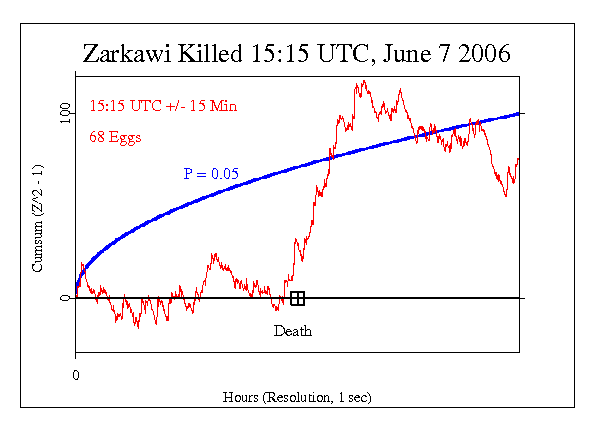
Now if we could only picture the death of war. Would that not be nice? It would be a surprise, and unique for sure, and it would evoke compassion and celebration in huge measure. Let's imagine how a graph of that moment would look.
Best, Roger
GCP/EGG Update June 27 2006
I just finished the analysis for the terrible earthquake disaster in Indonesia. The last news I saw indicated more than 3000 dead and 15000 injured. The EGG data show a strong response, and there is a tentative suggestion in the data of a precursor of a couple of hours–something I have been focusing on recently. You can see the analysis by clicking on the name in the last item of the formal results table at
The possibility of precursor responses is the topic of a paper I will be presenting at the AAAS meeting June 19-22 in San Diego in a symposium on retrocausation organized by physicist Dan Sheehan. Several others from the anomalies research field will be presenting, and I am looking forward to this somewhat unusual opportunity to present our findings in a mainstream venue. There is a little taste of the data we have at earthquakes. No certainty about this, but the indications justify further examination, and I hope to interest other scientists.
At the Society for Scientific Exploration meeting June 8 in Orem, Utah, I will talk about “data mining” as a potentially valuable approach to the GCP/EGG data. We have a background of formal hypothesis tests, but there is reason to believe that we can learn more by expanding the perspective to ask less formal, but still focused questions. The database appears to have more structure than can be seen through our usual analyses, and data mining tools help reveal this.
In July Lefty and I will join a group including Ron Russell and Joachim Koch for Project Avebury 2006. More information is at invitation to “join in our Great Meditation on July 22nd, 2006 at 11:00pm British Summer Time.”
At the Parapsychology Association meeting in Stockholm in August, I'll focus on data mining results for the last 8 New Years Eve events. I may have a chance also to talk about one of the most interesting developments in this vein. Bill Treurniet, who is the author of the EggAnalysis suite, has been exploring “event echoes” and FFT power spectra for some GCP events at treurniet.ca. As Bill says, more work is required, but “the presence of large spectral peaks immediately following selected events is additional support for the hypothesis that the EGGs respond to significant events.”
Old and much loved computers are vulnerable to wear and tear, and I had to finally accept that my main workstation, which began its continuous run in 2000, would have to be replaced. The complexities of recovering all the data and programs from my old system, plus setting up raid disks and various unfamiliar hardware bits took a long time but is nearly finished. The new machine is fine, but we're still getting to know each other.
I hope all goes well for you and yours. And I hope you hold a positive vision for the world at large. The data say this actually matters. Remarkable. What we envision has creative power. We need to use it well.
Best, Roger
GCP/EGG Update March 18 2006
It has been a long time since my last note, and there is a lot to tell about. I was traveling in India from December 10 to February 12, and doing catch-up since then. The EGG network stayed healthy the whole time I was away, producing its unrolling tapestry of data. I had little access to the server, so I couldn't register and analyse formal events as they happened, but did note a few, including the Hadj stampede (which, tragically, is a repetition), the giant mudslide in the Philippines, and the Golden Dome bombing in Iraq.
Of course there was New Years, the eighth in our long-running series of formal analyses of the transition, and there's a new twist. We did a thorough assessment of the last seven years to determine what effects are most consistent in the data around midnight, and in what timezones they are strongest. This “data mining” was used to formulate a refined hypothesis to apply to new data. As before, there are two tests, one that compares two measures that have shown consistent trends leading up to midnight, and one predicting a drop in variance to a minimum at midnight, and we use only 13 timezones with large populations. As the Results table shows, for 2006, one outcome was positive, the other negative. Links give more detail (in progress) for those interested in the data-mining approach.
And if you are interested in exploring the data yourself, we have a new package for downloading and analysing data from the GCP archives. The software was created by William Treurniet and is called EggAnalysis. More information and a download link at egganalysis This is a user-friendly application for Windows, in which you can specify the date and time for a data segment to examine. Analyses similar to our primary formal tests are automatically produced in graphical form, and there are options for several other perspectives on the data. William even included a facility for random music driven by the data. He is open to suggestions and will welcome feedback. This is definitely cool–especially for those with a “hands-on” interest in looking at the data.
We have new eggs Bermuda, Taiwan, South Africa, and Spain, and we're working on one in Chile. The number of active eggs remains about the same, between 60 and 65. Occasionally an egg host needs to drop out of the network for some reason, but is remarkable to consider that many of the hosts have participated for several years, some from the beginning of the project in 1998. They are all listed in the table at egghosts. The world map showing the eggs' placement has been updated and corrected, thanks to a note from Hawaii. Feedback really is helpful.
In addition to the egg hosts, there is a long list of people, more than two dozen, who have contributed major chunks of time-consuming work to the project. It goes without saying that the GCP wouldn't exist without them, and I know I speak for everyone reading this when I say we are grateful. There is a listing of “Production Credits” with their names at programming
Our time in India was rich in more ways than I can tell here. I have made a webpage with some travel notes that touch on the most striking experiences, as well as hundreds of pictures, many with annotations–more to be done. I had a digital camera and often took 50 or 100 photos in a day. Of course only a few are good, but they have a story to tell. Take a look if you have some time to while away.
While there, I gave formal talks at six places with a range of perspectives from academic to scientific to spiritual. In India, I felt a greater freedom to go beyond the data to talk about interpretations and implications. That is partly because I was “preaching to the choir” and suggesting ideas that are part of the ancient teachings familiar in all the major Indian religions. (An aside: tolerance and respect for many spiritual modes is a beautiful quality of Indian life.)
For the next months, my schedule includes a talk March 28th to a Princeton Unitarian group, the SSE meeting in Salt Lake early June, a AAAS symposium on the physics of time in late June, San Diego, a possible visit to Avebury in July, and the PA meeting in Stockholm in August. I'll hope to meet some of you when paths cross. The GCP, represented by Peter Bancel, will show up as a bit of scientific leavening in a National Geographic TV special looking at Prophesy. I don't know the dates, but they originally intended to air in March or April.
There is more to tell , but we all get too much to read, so I'll end this with a wish for good health for our planet as well as for all of us. Tall order, given the imbalance of power and wisdom in the world today, but every one of us has the power to add a little wisdom to the scales. And we will.
Best, Roger
GCP/EGG Update November 21 2005
It's been a busy time of travel and meetings, often with people and purposes that are aligned with the GCP's and, most likely, with yours as well.
In September, Lefty and I went to Unity Village near Kansas City. It's a beautiful campus that is the center of a worldwide, inclusive spiritual movement. I had a whole morning to talk with ministerial students and others about the technology of research on interactions of consciousness and environment, and the evidence for “Interconnecting Minds: Signs of a Global Consciousness.”
In late October I joined about 40 other people at a conference in Ashville NC on Universal Awakening. This is a new organization, with a mission to think deeply about how to be active in bringing us to a future that is the product of our highest human capacities. More at universal-awakening.org
A few days ago, I gave a talk at Temple Medical School Grand Rounds for Psychiatry. Interesting experience. Physicians and Psychatrists are very practical people, interested in making things work, so they had solid, skeptical questions, but they could see confirmation of their own subjective insights that touch on how we live in the world–sometimes with ease, other times with immense difficulty.
Our friends at the Lifebridge Foundation have just opened the Lifebridge Sanctuary, a retreat setting for non-profits who are looking for a beautiful private space for group reflection, creative thinking and cutting edge conversation. For further information: lifebridge.org/sanctuary
We have a couple of new eggs, and we have lost a couple of long-running eggs to the difficulties of networking in a time of spam and virus-hacking. Getting our data through firewalls was not a consideration in 1998, but it is now. An interesting sign of both the longevity of the project and of the changing nature of our technological interconnectedness. Some aspects grow more transparent, but others more obscure.
It makes me think of the truly immense tasks before us as “masters of our destiny.” The tools we create as the newest and best manifestations of our creativity and potential come with complexities and side effects, unintended consequences, that are potent, and definitely not planned for. It is daunting to envision the developing ensemble of human progress (which seems sometimes to point in the other direction–but our work suggests that positive expectations are the way to go.)
The formal event sequence that is the primary analysis for theGCP includes samples both positive and negative, but one of the clearest results continues to be that compassion is a defining characteristic of the events that most strongly affect the EGG network. That should be no surprise, of course, because this is the common ground or core of the interactive, interdependent group or global consciousness that we're touching.
While traveling in December and January I probably will have occasional access to the Internet, but less than usual. Email will continue to be the best way to contact me. Perhaps I'll send out another note before leaving, but if not, let me wish you now the best for the next coming holidays, wherever you may be.
Best, Roger
GCP/EGG Update 2 October 2005
I am happy to report that the noosphere server is up, as of the 30th Sept, after just a day of down time. My wizard son Greg helped establish that there was no damage, and our best guess is that the basic problem was a transient hardware glitch. We were concerned by a flood of data requests that looked like a denial of service attack, but it seems these were just a secondary manifestation of a temporarary memory overload.
The delicate balance of facilities and structures in computer systems is amazing, and it is interesting to focus on that remarkable presence in the world. I must admit to some level of anxiety while the server was down. It is easy to become accustomed to our tools and facilities just being there, and a lapse reveals something of our intimate dependencies. I actually missed the noosphere server and the GCP's lively presence in my every day. And that is such a trivial matter compared to the enormous losses suffered from Hurricane Katrina in the Gulf states and New Orleans. What a lesson, if only we would step back and learn from it.
So, I am happy we're back online, not least because it is possible to look at the EGG network's response to Katrina. The primary test on the first day was not significant, but the next few days show variance fluctuations almost as large as those on Sept 11 2001. (Linked from Results table.) This is a perspective we will study more carefully in future analyses, as part of a focus on learning more about effective measures and their interpretation.
Again I commend to you the earthquake analyses by Peter Bancel. There is plenty of careful work to do before we can fully understand the potential and confidently interpret this work, but it is exciting. Have a look. The direct URL is earthquakes, and especially the last part, on “precursor” indications.
Some new events have been added to the Results table, including Katrina, the tragic stampede in Baghdad, and the recent rally against the Iraq war in Washington. If I have time before leaving, there is also an un-analysed prediction concerning the terrorist bombings in Bali that will be added. Results.
There are also some new musical interpretations of GCP data at music by Phillip Wood and by Jeff Robertson. Links are at the bottom of the page. And though I haven't seen it yet, Mike Leznoff has made an animation of the changing tapestry that appears on the home page. He says “the motion accentuates the bilateral patterns–it's almost hypnotic....” I'll put a piece of that on the website when it becomes available.
I can also introduce some new egg hosts. The most recent are Adam Ward in Taiwan, and Walter Cooke in Bermuda. In the past few months we also have added eggs in Mexico, Natalie Larrode, in Estonia, Henri Laupmaa, in Malasia, Arthur Eeckart, in Colombia, Sergio Carvajal, and Argentina, Andres Kievsky. Not sure I introduced all of these folks in previous notes.
Nice to be back in business. It would be still nicer if all the reporting in my update were about pleasant, positive events. But as they say, “It's all good.” For sure it is all what it is, and accepting “what is” must be the first step in creating what will be.
Best, Roger
GCP/EGG Update 20 September 2005
I have been feeling it is time for an update for a while, and now have a particular need to send one.
The noosphere server is down, as of late on the 29th Sept, so there is no access to the website, nor can the eggs report their current data. So this update is partly a note to egg hosts to let you all know the situation. Your eggs will continue to store data for reporting when the server is up and running again. I hope it will turn out to be a minor problem but I will not be able to determine this until later today.
When we're back online, one item you may find especially interesting is the continuing earthquake analysis by Peter Bancel. Previously I wrote about the clear indications of an effect that is evidently dependent on the importance of major quakes to human consciousness. There is also information that can help us think about the nature of the GCP/EGG network response, including theoretically important issues such as locality. Peter's most recent work shows the time course of the response, and it appears that it begins well before the primary temblor of the earthquakes. This is (as always in our data) a subtle correlation, so it typically does not show in a single event, but requires signal averaging over many earthquakes. (The huge tsunami quake is an exception, and it does show the general pattern.) I hope you will be able to look at these findings soon. The direct URL is earthquakes.
I will make this short, and will send another update as soon as the server is available. We have had some major events, I will make this short, and will send another update as soon as the server is available. We have had some major events, including the disaster in New Orleans and the gulf states in the US. As you may guess, it is odd to write to you about what you might be interested in looking at if only the noosphere server were running.
My best to you all,
Roger