Peace Intention Experiment |
|
The Peace Intention Experiment involves a well-publicized and promoted effort to have large numbers of people participate in a group meditation specifically directed to increasing peace in a particular place in the world. This is the description from the Peace Intention website.
Although the primary measures to assess the effect of this Peace Intention experiment are similar to those developed by the TM researchers, namely social metrics, we decided to also look at the data from the GCP corresponding to the period of the organized meditation. The period set was the 10 minute meditation with 15 minutes on either side, a total of 40 minutes each day. This inclusive period is responsive to the Peace Intention instructions asking people to begin their preparation 15 minutes early, and the typical finding that attentional and emotional engagement persists for some time after its primary stimulus. The formal result, shown in the figure below, is very similar to a frequent outcome for organized and focused meditations. In particular, they resemble our findings for several TM meditations with related context. The chisquare is 16523.045 on 16800 df, for p=0.935 and Z=-1.516. Note added Jan 2012: A replication of this experiment in Sept 2011 shows a similar outcome.

While we know the GCP data are not precise (the signal to noise ratio is much too small) it is interesting to ask what the concatenation looks like if we examine just the 10 minutes specified in the experimental design. This is shown in the next figure, which also has a generally downward trend, especially on the first two days and the last two. The statistics are a little weaker, with Chisquare 4108.217 on 4200 df, p=0.842 and Z=-1.001.
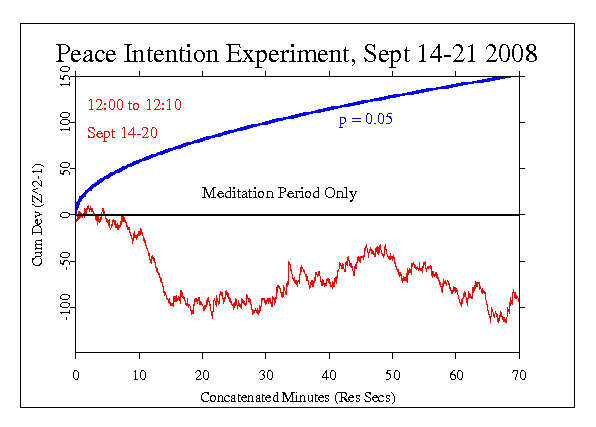
It is important to keep in mind that we have only a tiny statistical effect, so that it is always hard to distinguish signal from noise. This means that every "success" might be largely driven by chance, and every "null" or "negative" outcome might include a real signal overwhelmed by noise. In the long run, a real effect can be identified only by patiently accumulating replications of similar analyses. In this case, we the outcome adds to the general trend we find for similar or related events.
|