Health Care Reform
Health Care Reform has been a major goal for the Obama Presidency and the Democratic party. The year long push against powerful forces and a fully opposed Republican party finally came to a victory celebration with Obama signing the health care bill into law on March 23, 2010.
From a Washington Post article:
The 15-foot-tall wooden doors behind the podium slid open around 11:30 a.m., offering a glimpse down a long, column-lined corridor of a portrait of President Bill Clinton on a distant wall. Obama and Biden, each in a navy-blue suit, white shirt and navy-blue tie, entered to applause and chants of
Fired up, ready to go!from lawmakers, some of whom had questioned the president’s commitment, tactics and policy goals over the past year.In his speech, Obama thanked the lawmakers for their
historic leadership and uncommon courageduring a year of fierce opposition, acknowledging that they hadtaken their lumps during this difficult debate.
Yes, we did,shouted Rep. Gary L. Ackerman (D-N.Y.), drawing laughter from his colleagues with his play on Obama’s campaign slogan.
After a brief congratulatory speech, which named many who had worked untiringly, and named also his several predecessors who had tried mightily to reform the U.S. health care system, Obama put pen to paper (actually 22 pens), bringing to an end many decades of efforts to improve how we do this most personal and most urgent work.
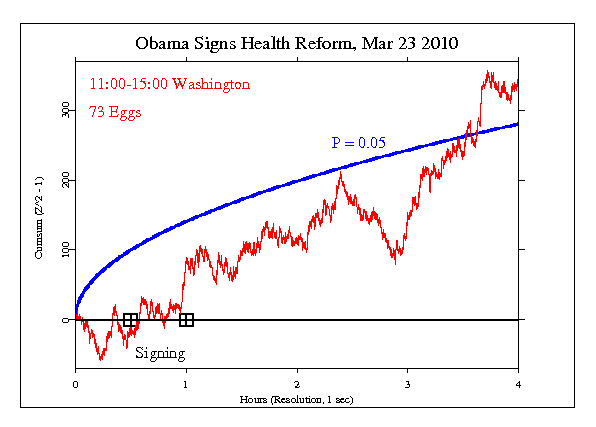
The GCP event was set for 11:00 to 15:00 Washington time (15:00-19:00 UTC), which includes half an hour before the beginning of the ceremony, and 3 hours or so after the signing. The actual signing was probably around 11:45 plus or minus 15 minutes. The result is Chisquare 14736 on 14400 df for Z=1.971 and p=0.024.
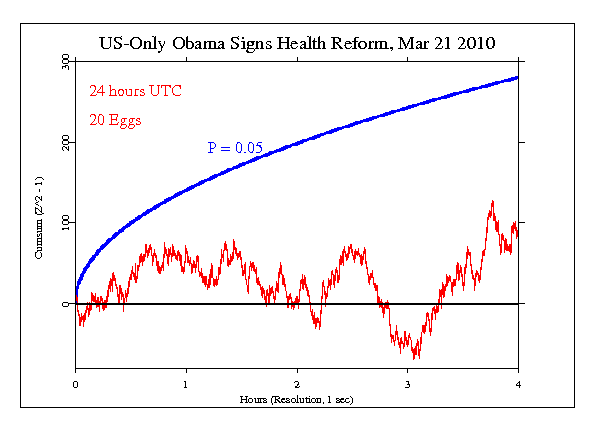
Exploration: A reasonable question to ask, despite the small S/N ratio of GCP data, is whether the health care reform issue shows up most strongly in the data from eggs in the U.S.. It is, as have been other Obama-related events, of interest to many in the rest of the world, but it affects U.S. citizens most directly. The answer to the question is a modestly persuasive no. The effect for 20 U.S. eggs is positive, but not as strong as when the full network is used. This outcome may be an excellent example of the fact that the effect size is too small for reliable interpretation of individual events (or comparisons of subsets or single Eggs. See also the note at the end of this page.
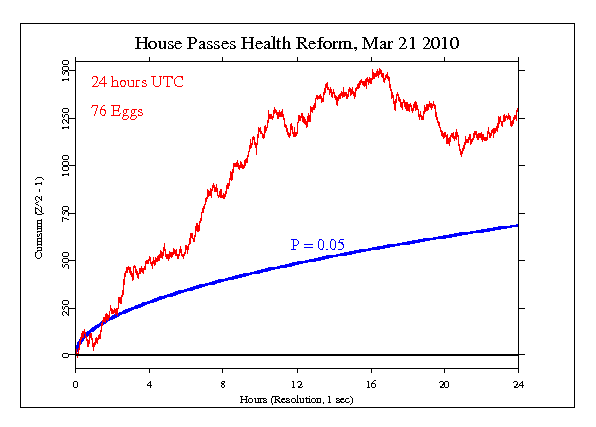
Exploration: On the 25th of March, Dick Shoup emailed the suggestion that the preceding Sunday should be an event: ... how about an event at the time of the passage of the health care bill in the House? TV coverage was extensive all that day (Sun 3/21).
He added, It seemed to me that all day Sunday was a long drawn-out emotional buildup to the final vote, and lots of people were paying at least peripheral attention throughout via tv or radio.
The formal event had already been set, but we proceeded with an exploratory assessment of Dick’s proposed event, and the result is a striking vindication of his intuition. Had this been an a priori prediction, the associated probability would have been 0.001 (Z=3.115).
It is important to keep in mind that we have only a tiny statistical effect, so that it is always hard to distinguish signal from noise. This means that every success
might be largely driven by chance, and every null
might include a real signal overwhelmed by noise. In the long run, a real effect can be identified only by patiently accumulating replications of similar analyses.
