|
The "Fire The Grid" event set for July 17 2007 brought a
huge number, perhaps 10 times as many as for
similar events, of notes from around the world, interested in
notifying me of it and asking whether we would look at it as a
GCP event. We decided early that it would be included in the
formal series, and specified exactly the time defined by
Shelley Yates in her presentation and descriptions.
Here is an example email, which has the necessary
information and some interpretations that help explain how
the event is of importance:
Some of you may have heard of this, some may not. But it is
simply this:
On July 17, at 11:11 Greenwich mean time (7:11 EST) there
will be
thousands, perhaps millions of people who will attempt to
heal the
planet by raising their own energy vibrations and sending
them out to
connect with those of others.
To join, you don't have to pray or meditate (although if
that's what
makes you happy, bring it on...:-) Simply engage in anything
that brings
you joy: listen to your favourite music, hug your children,
walk your
dogs and let the joy of life fill you up. Thank the universe
for this
special moment and imagine yourself spilling over with a
brilliant light
that you send out to connect with that of others.
The idea is this: Everything in the universe has a
vibration. When you
feel down and depressed, your vibrations are low. With all
the problems
that are facing us, humanity and our environment, we have
all become
preoccupied with our difficulties and their associated
fears. Slowly,
our own and our planet's vibrations have become depleted.
If we can all raise our vibrations at the same time, we can
raise those
of the Earth and start the healing process. Give it a shot!
You've got
nothing to lose and everything to gain.
To raise your vibrations on a daily basis do this:
- Be in the moment
For instance, we all have put food in our mouths while
being
distracted.
Taste it, feel it filling you up and savour the sensation.
Do this with all things as often as possible.
- Give thanks to the universe, even if it's just for a great
parking
spot
- Love and forgive yourself.
- Live your life to enrich that of others
To learn more about Fire the Grid, you can watch here:
http://www.youtube.com/watch?v=cqUAluDvuU4
Or visit:
http://www.firethegrid.com/eng/home-fr-eng.htm
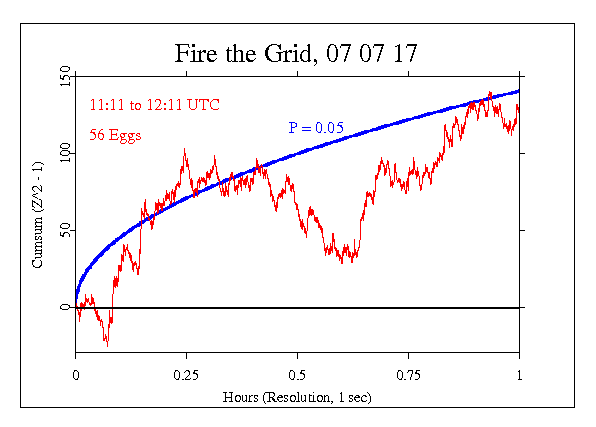
The formal event was defined as the one hour period from
11:11 to 12:11 GMT on July 17.
The Chisquare is 3731.7 on 3600 df, for p=0.062 and
Z=1.542. This is in accord with the prediction, and is
marginally significant.
Below, we provide exploratory analyses that give some
context for the formal analysis, since so many people are
interested. It is important, however to understand that
single events are not expected to answer the subtle
questions we ask in the GCP. Because the average effect
size is small (Z ~ 0.3) we cannot generally interpret
single events with reliability; we need repeated tests of
the same type of hypothesis. That having been said, we see
that the Fire the Grid event has a positive outcome,
consistent with the prediction, and indeed shows a
larger deviation than the average.
I encourage people interested in this and other occasions
that bring us together to meditate or pray for a better
future to trust your/our feelings and direct perceptions of
the effects. The GCP analyses are a very interesting
adjunct, but they should not be seen as a test of the intent
or success of the gathering of minds for good purpose.
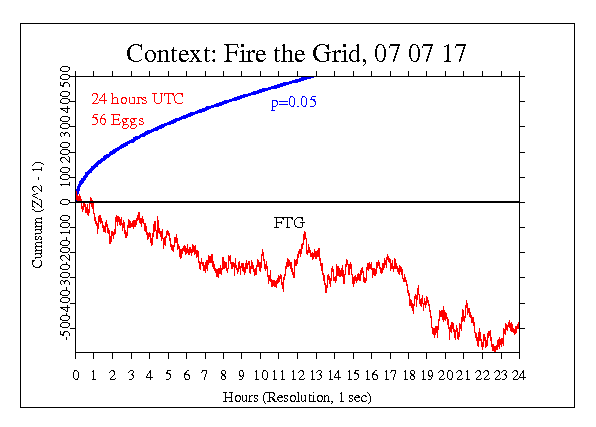
The full day of July 17 (UTC) is shown in the next graph,
with the hour-long Fire the Grid (FTG) event marked. While
the cautions about interpretation of single analyses apply
here also, it is interesting to note that the FTG presents a
notable "spike" of positive trend on a rather consistent
day-long background trend that is negative.
i
Again, we do not believe it is appropriate
to interpret single events even though it is tempting to do
so when the "picture" looks good. The signal to noise ratio
is way too small, and to make claims based on any single
experiment in this domain is potentially misleading. It happens
in this case that the FTG event is one in a decent size
collection we have assembled over the years, and it is
consistent with the general outcome. Good stuff, but just
the beginning of learning about the stuff.
Numbers Engaged
We have modestly persuasive evidence that the effects in GCP data are a
function of the numbers of people engaged. When millions are
likely aware of an event and likely participatory in some
sense, the effects are larger and more reliable. We don't
have an objective count and have to rely on estimates and best
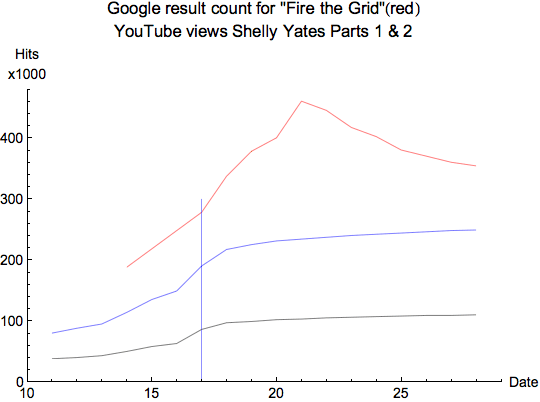
guesses for the most part. The Fire the Grid event provided
an opportunity to look at web-based counts, as a step toward
a useful measure of N. Here is what Google and YouTube
looked like over the time around the FTG event.
|